

Sustainable Bottom Line: Stepped up disclosures of sustainable investing strategies in stewardship reports by investment management firms offers investors an expanded number of investment options.
Takeaway: Nearly every one of the fifty largest asset managers globally now publishes some form of stewardship or ESG-integration disclosure — but only five provide the fully quantified, scope-explicit account of where those policies apply, and where they stop, that separates a genuinely transparent program from a well-intentioned commitment. For the other forty-five, the shortfall is rarely a shortfall in activity; it is a shortfall in precision about which asset classes, mandates, and legal entities a stated policy actually covers.
Introduction
Investment management firms are increasingly disclosing their sustainable investing strategies in stewardship reports or related disclosures, including insights into each firm’s engagement and proxy voting practices. A stewardship report by an asset management firm is a public disclosure detailing how the firm fulfills its fiduciary duty to protect and enhance clients’ long-term investments. The report generally outlines the firm’s activities regarding sustainable investing, corporate engagement (dialogue with company management), proxy voting at shareholder meetings to promote sound governance and sustainable financial value, and more. Such disclosures benefit all investors, including sustainable investors, particularly those that are attracted to an ESG integration approach (1) to sustainable investing, a segment that, by one measure, accounts for 77% of sustainable investors. At a time when the number of labeled sustainable funds is declining due to fund closures, reorganizations as well as re-brandings and the number of investment options contracted, stewardship reporting offers sustainable investors a pathway to expand their investment options beyond labeled funds to include conventional funds and investment strategies offered by reporting firms.
A still in development Stewardship Evaluation Framework with a Focus on Stewardship & Disclosure
While still in the development stage with further refinements to follow, a Stewardship Evaluation Framework developed by Sustainable Research and Analysis to compare how asset managers publicly disclose and practice investment stewardship has been applied to the 50 largest asset management firms globally based on assets under management, spanning roughly $60 trillion in combined assets. These 50 firms are headquartered across multiple jurisdictions, including the United States, the United Kingdom, the European Union, and Japan, and stewardship and ESG-integration disclosure practices, and the regulatory regimes that shape them, vary meaningfully by home market. Each firm is scored on a 1-to-5 scale across six weighted dimensions: Stewardship & Disclosure, Governance & Resourcing, Transparency & Reporting, Outcomes Measurement & Impact Rigor, Codes, Standards & Regulatory Alignment, and Data Integrity, Candor & Assurance. Each dimension is assigned a weight and scored individually but weights are subject to change. The scores combine into a single weighted composite score. Exhibit A, at the end of this article, lists all 50 firms in order of assets under management.
In its current iteration, Stewardship & Disclosure carries the heaviest weight of the six dimensions (25%, versus 15% for each of the other five) because it measures something the other five dimensions depend on: whether a reader can even establish which parts of a firm’s business its stewardship and sustainable investing claims actually cover. A firm cannot be meaningfully assessed on the rigor of its outcomes measurement, the strength of its governance, or the candor of its data if the reader cannot first tell which asset classes, mandates, and legal entities those claims apply to.
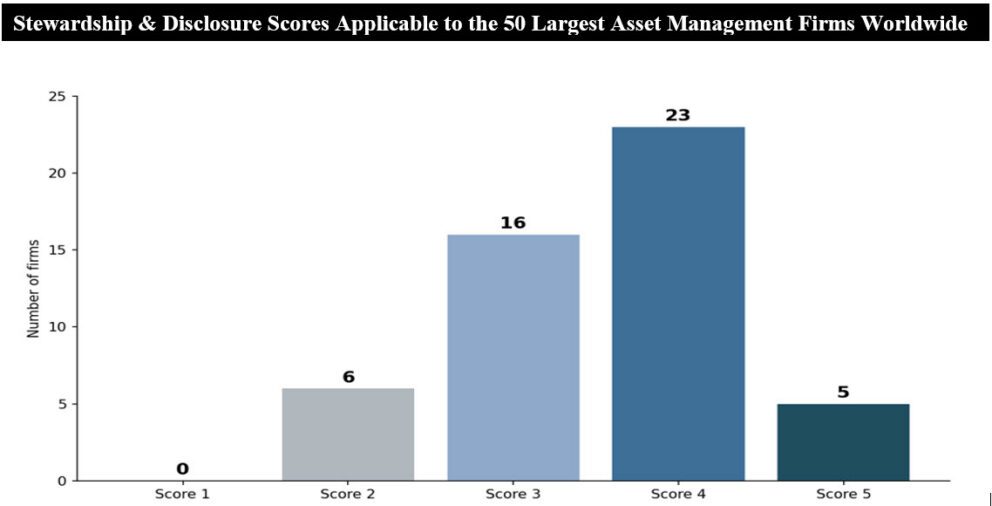
This article only addresses the Stewardship & Disclosure dimension of the Stewardship Evaluation Framework on a stand alone basis which, as noted, is still in the process of development. An evaluation of Stewardship and Disclosure across all 50 firms indicates that 44 of the 50 firms offer at least a clear disclosure of policy application — covering ESG integration, proxy voting, and engagement — for at least one major asset class or mandate type (16 firms), while 28 of those 44 go further and provide detailed to comprehensive, differentiated disclosure across multiple asset classes and mandate types (e.g., active vs. index, equity vs. fixed income vs. alternatives), including explicit scope limits. The remaining 6 firms disclose something concrete, but a major part of the business is explicitly excluded from what is disclosed, and none of the 50 firms was found to offer no meaningful disclosure at all. Such disclosures apply not only to mutual funds and ETF assets under management but also to separate accounts managed on behalf of institutional investors, insurance companies, and family offices, among others.
 Notes of Explanation: Scores range from a score of 5 (highest score) to 1 (lowest score). Refer to the definitions of the five scores. Source: Sustainable Research and Analysis LLC.
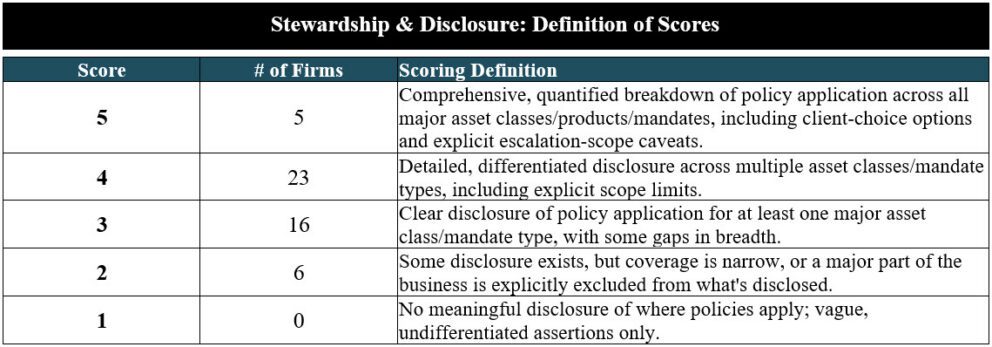
The scoring definitions and results for the Stewardship and Disclosure dimension across the range of outcomes from 1-5 are set out below.
 Notes of Explanation: Scores range from a score of 5 (highest score) to 1 (lowest score). Source: Sustainable Research & Analysis LLC.
Score of 5: Comprehensive, Quantified, and Explicit About Limits
Five firms achieve the top score: BlackRock, BNP Paribas Asset Management, AllianceBernstein, Generali Investments, and Eurizon Capital. What distinguishes all five is precision rather than volume of prose — each publishes a scoped, numeric account of exactly where its stewardship and ESG-integration policies apply, and where they stop.
BlackRock discloses precise AUM splits between its index-strategy stewardship team (BIS) and its active-strategy team (BAIS), down to the dollar amount of assets enrolled in its Voting Choice program and the number of voting-guideline options clients can select from. BNP Paribas Asset Management’s PRI Transparency Report includes a complete, standardized ‘ESG Incorporation’ checkbox breakdown across every internally managed asset class. AllianceBernstein discloses that ESG-integrated assets represent $596 billion, or approximately 68% of the firm’s actively managed AUM. Generali’s Active Ownership Report quantifies its engagement population precisely (72 engagements, 64 counterparties) with an explicit caveat that its published voting statistics cover only the portfolios where Generali actually holds discretionary voting power. And Eurizon Capital’s ESG Incorporation module marks ‘Yes’ across every internally managed asset class it reports, including passive equity — a distinction most peers in this review do not achieve.
The generalized basis for a 5, in other words, is not simply having a stewardship program — it is publishing a scoped, numeric account of that program’s boundaries, including the parts a firm chooses not to cover.
Score of 4: Clearly Differentiated, With Minor Gaps
Twenty three firms scored a 4, the largest single tier: J.P. Morgan Asset Management, State Street Global Advisors, Legal & General Investment Management, Nuveen, Amundi, Northern Trust Asset Management, PIMCO, Federated Hermes, Dimensional Fund Advisors, Morgan Stanley Investment Management, Ameriprise Financial (Columbia Threadneedle), Schroders, Sumitomo Mitsui Trust/Amova Asset Management, DWS Group, Principal Asset Management, HSBC Asset Management, Neuberger Berman, Nordea Asset Management, Aberdeen, M&G, Nomura Asset Management, APG Asset Management, Aegon Asset Management.
These firms clear a common bar: distinct, asset-class-specific descriptions of how stewardship and ESG integration are applied — separate treatment of equities, fixed income, real estate, and private markets, rather than one generic policy statement covering everything. Several anchor that claim with a precise, quantified figure: Amundi states that 100% of its actively managed open-ended funds carry ESG performance objectives, subject to a specifically named list of exceptions, while Federated Hermes’ own Activities and Outcomes Report lays out an asset-class-differentiated integration statement covering its six investment capabilities directly (equities, fixed income, private debt, real estate, infrastructure, and private equity), with one specifically named exclusion. Ameriprise/Columbia Threadneedle and Nomura each publish a complete, standardized ‘ESG Incorporation’ breakdown, via the PRI Transparency Report framework, naming exactly which strategies are covered and which are not.
Others in this tier earn their score through candor about limits: Legal & General frames its heavily index-based book through an explicit “universal owner” rationale; Northern Trust states plainly that engagement is applied consistently across both active and passive strategies; Dimensional states, with unusual bluntness, that its core systematic strategies do not integrate ESG factors into security selection at all, reserving integration for a separate, named menu of strategies; Schroders requires an annual ESG-integration accreditation across all 60-plus investment desks; HSBC discloses a three-tier structure that differentiates active-fundamental, quantitative, and passive strategies; Nordea’s SFDR-mandated disclosure describes how sustainability risk is folded into its investment decision-making framework; M&G discloses, rather than glosses over, the roughly 7% of assets where day-to-day stewardship is delegated to external managers; and APG discloses that its engagement priorities are set by the mandates of four named pension-fund clients rather than a house-wide policy; and Aegon Asset Management publishes a dedicated integration process for each of its three investment platforms — equities, fixed income, and multi-asset — while candidly disclosing the segregated mandates where it has limited discretion over stewardship activity.
What keeps this group at a 4 rather than a 5 is typically one remaining gap — a missing quantified AUM-by-mandate split, an escalation tool that is not extended to every asset class, or a policy still catching up to a firm’s actual scale and structure.
Score of 3: Real Disclosure, But with an Unaddressed Blind Spot
Sixteen firms achieved a score of 3: Invesco, Fidelity Investments, Capital Group, Wellington Management, Prudential Financial/PGIM, T. Rowe Price Associates, Franklin Templeton, MetLife Investment Management, Mercer, UBS Asset Management, Manulife Investment Management, RBC Global Asset Management, New York Life Investments, Janus Henderson, MUFG Asset Management, Barings.
A score of 3 typically reflects genuine, substantive disclosure for at least one major part of the business, paired with a significant piece left unaddressed. The most common version of this gap is silence on passive or index strategies: Invesco details six distinct active asset-class teams but never explains how stewardship applies to the more than 40% of its assets held in index and passive fixed-income strategies. A second recurring pattern is single-entity or single-document scoping that leaves the rest of a larger organization unaddressed — Fidelity’s disclosure covers only Fidelity Management & Research Company, leaving the rest of the broader Fidelity organization unaddressed. A third pattern is candor without depth: several firms in this group (Wellington, Franklin Templeton, RBC GAM) openly acknowledge that stewardship approach varies by team or affiliate rather than following one firm-wide standard — an honest disclosure, but one that stops short of the itemized, quantified breakdown that separates a 3 from a 4. A fourth pattern is real but thin or dated disclosure: Manulife names a specific and structurally significant exclusion (the Manulife General Account insurance book, which follows separate ESG guidelines); New York Life Investments describes an actual per-boutique ESG tiering framework; MUFG Asset Management gives a specific entity- and asset-class-level scope statement, though the underlying document is several years old; and Barings’ PRI Transparency Report includes a complete ‘ESG Incorporation’ breakdown covering most of its internally managed asset classes, even as its narrative stewardship disclosure remains comparatively narrow.
Score of 2: Some Disclosure, but a Major Part of the Business Is Explicitly Excluded
A score of 2 captures disclosures that exist but are narrow, or ones that explicitly exclude a major part of the business, active or sub-advised funds, alternatives, or passive/index strategies, from what is disclosed. Six firms scored a 2: Vanguard, Goldman Sachs Asset Management, BNY Investments, Geode Capital Management, Charles Schwab Asset Management, Natixis Investment Managers.
The disclosures of each of the six firms are accurate as far as they are concerned, however, each firm leaves a named, material segment of the business outside of what can be evaluated. Vanguard’s flagship stewardship report is explicitly scoped only to internally managed index and quantitative equity funds; the report itself states that it excludes proxy voting and engagement for externally managed funds handled by third-party sub-advisors, along with Investor Choice program votes, and no fixed income or alternatives coverage appears anywhere in the document. Goldman Sachs Asset Management’s stewardship report is explicitly and repeatedly confined to its Public Markets Investing Business; the firm’s substantial alternatives and private-markets business — a meaningful share of GSAM’s roughly $3.65 trillion in assets under supervision — is absent from the document altogether. BNY Investments itself publishes no firm-wide stewardship disclosure; the closest available evidence, from its Newton affiliate, explicitly excludes ETFs and certain quantitative-driven strategies from ESG consideration, and discloses that legacy equity holdings inherited from a predecessor entity have not had ESG assessments at all. Geode Capital Management’s only public disclosure of any kind is a proxy voting policy — not a stewardship report or an ESG-integration statement — candid about Geode’s business being predominantly passive and index-based but silent on governance, team structure, or how ESG factors enter the investment process. Charles Schwab Asset Management discloses a general voting philosophy, oriented around board composition, strategic performance, and reporting clarity, but with no asset-class breakdown or scope caveats, and its own annual Investment Stewardship Report is not readily accessible to an outside reader. Natixis Investment Managers International discloses its multi-affiliate delegation model clearly and honestly — portfolio management, and with-it stewardship activity, is delegated in full to affiliate managers, each with its own separate voting policy — which itself means NIMI has little direct stewardship activity of its own left to disclose. That said, it is acknowledged that more work is called for here to fully tease out the approach being taken by affiliated firms.
Score of 1: No Meaningful Disclosure (Not Observed Among These 50 Firms)
The bottom of the scoring range describes a firm offering “no meaningful disclosure of where policies apply; vague, undifferentiated assertions only” — language amounting to a generic commitment to responsible investing with no identifiable policy document, asset-class detail, or scope statement of any kind.
No firm among the 50 evaluated here scored a 1. Even the six firms at the floor of this review clear that bar: each publishes something concrete enough to evaluate — a proxy voting policy, an affiliate’s stewardship report, or a public webpage describing a voting philosophy — even where a major part of the business sits outside it. The absence of any 1 is itself a modest finding: among the fifty largest asset managers evaluated here, none has entirely opted out of stewardship disclosure, even though several disclose only a fraction of what a comprehensive policy would require.
Why This Dimension Carries the Most Weight
That only 5 of 50 firms reach the top score, while 22 sit at a 4, 17 at a 3, 6 at a 2, and none at a 1, suggests an industry in which the underlying activity — proxy voting, engagement, ESG integration — is now widespread, but a fully scoped, quantified account of where that activity applies remains the exception rather than the rule. Stewardship & Disclosure is weighted at 25% — a full ten points above every other dimension — precisely because it is the foundation the other five dimensions build on: a firm’s outcomes measurement, governance, and data candor cannot be meaningfully assessed until it is first clear which parts of the business its claims actually cover.
(1) ESG integration refers to accounting for relevant and financially material environmental, social and governance factos in investment decision making.
Exhibit A: The 50 Firms by Assets Under Management
The 50 firms evaluated in this article, ranked by approximate assets under management, with each firm’s Stewardship & Disclosure (Dimension 1) score from this review shown alongside it. Figures are drawn from each firm’s most recent public disclosure available at the time of this review (generally year-end 2025 or Q1 2026), converted to US dollars at approximate exchange rates where reported in another currency, and rounded to the precision at which each firm itself reports. Because reporting dates, entity scope, and disclosure conventions vary by firm, these figures are best read as an approximate size ordering rather than a precise, same-date comparison.
Rank | Firm | Assets Under Management | D1 Score |
1 | BlackRock | $13.9T | 5 |
2 | Vanguard | ~$12.0T | 2 |
3 | Fidelity Investments | $7.0T | 3 |
4 | State Street Global Advisors | $5.6T | 4 |
5 | J.P. Morgan Asset Management | $4.3T | 4 |
6 | Goldman Sachs Asset Management | $3.65T | 2 |
7 | Capital Group (American Funds) | $3.4T | 3 |
8 | Amundi | ~$2.7T | 4 |
9 | PIMCO | $2.27T | 4 |
10 | Invesco | $2.2T | 3 |
11 | BNY Investments | $2.1T | 2 |
12 | UBS Asset Management | $2.1T | 3 |
13 | Morgan Stanley Investment Management | $1.9T | 4 |
14 | T. Rowe Price Associates | $1.89T | 3 |
15 | Geode Capital Management | $1.88T | 2 |
16 | BNP Paribas Asset Management | ~$1.8T | 5 |
17 | Northern Trust Asset Management | $1.78T | 4 |
18 | Ameriprise Financial (Columbia Threadneedle) | $1.7T | 4 |
19 | Franklin Templeton | $1.68T | 3 |
20 | Charles Schwab Asset Management | $1.64T | 2 |
21 | Natixis Investment Managers | $1.55T | 2 |
22 | Legal & General Investment Management | ~$1.5T | 4 |
23 | Prudential Financial (PGIM) | $1.43T | 3 |
24 | Nuveen | $1.40T | 4 |
25 | Wellington Management | ~$1.3T | 3 |
26 | DWS Group | ~$1.15T | 4 |
27 | Schroders | ~$1.1T | 4 |
28 | Dimensional Fund Advisors | ~$1.0T+ | 4 |
29 | AllianceBernstein | $867B | 5 |
30 | Mercer | $846B | 3 |
31 | Nomura Asset Management | ~$812B | 4 |
32 | New York Life Investments | $800B+ | 3 |
33 | Principal Asset Management | $781B | 4 |
34 | HSBC Asset Management | $765B | 4 |
35 | MetLife Investment Management | $736.3B | 3 |
36 | Generali Investments | ~$715B | 5 |
37 | Federated Hermes | $704B ² | 4 |
38 | APG Asset Management | ~$665B | 4 |
39 | MUFG Asset Management | ~$642B | 3 |
40 | RBC Global Asset Management | $571B+ | 3 |
41 | Neuberger Berman | $558B | 4 |
42 | Nordea Asset Management | ~$545B | 4 |
43 | Barings | $502B | 3 |
44 | Aberdeen | ~$495B | 4 |
45 | Janus Henderson | $493B | 3 |
46 | Eurizon Capital | ~$445B | 5 |
47 | M&G | ~$440B | 4 |
48 | Aegon Asset Management | $348B | 4 |
49 | Sumitomo Mitsui Trust (Amova Asset Management) | $274.3B | 4 |
50 | Manulife Investment Management | $230.6B | 3 |
¹ ‘Stewardship report’ is used throughout this article as shorthand for the full range of source materials reviewed, which varies by firm and by the jurisdiction and regulatory regime a firm reports under. Materials reviewed include dedicated stewardship or active-ownership reports; UK Stewardship Code compliance submissions; PRI (Principles for Responsible Investment) Transparency Reports; EU SFDR-mandated sustainability disclosures; standalone responsible-investment, sustainable-investing, or ESG-integration policy statements; and proxy-voting and engagement policies, among other formats. The specific document(s) relied on for each firm, and their scope and any gaps, are documented individually on the Scoring Rationale tab of the accompanying workbook.
² Federated Hermes: figure shown is Federated Hermes, Inc.’s approximate firm-wide AUM. The Dimension 1 stewardship-and-disclosure score elsewhere in this article evaluates Federated Hermes Limited (FHL) specifically — the UK-based active asset-management business within the Federated Hermes group — which manages approximately $52 billion directly; FHL’s parent group separately includes a much larger US-based money-market and fixed-income fund business.