


Sustainable Bottom Line: Pass-through proxy voting with an ESG option offers some sustainable investors an avenue to express sustainability preferences while investing in conventional funds.
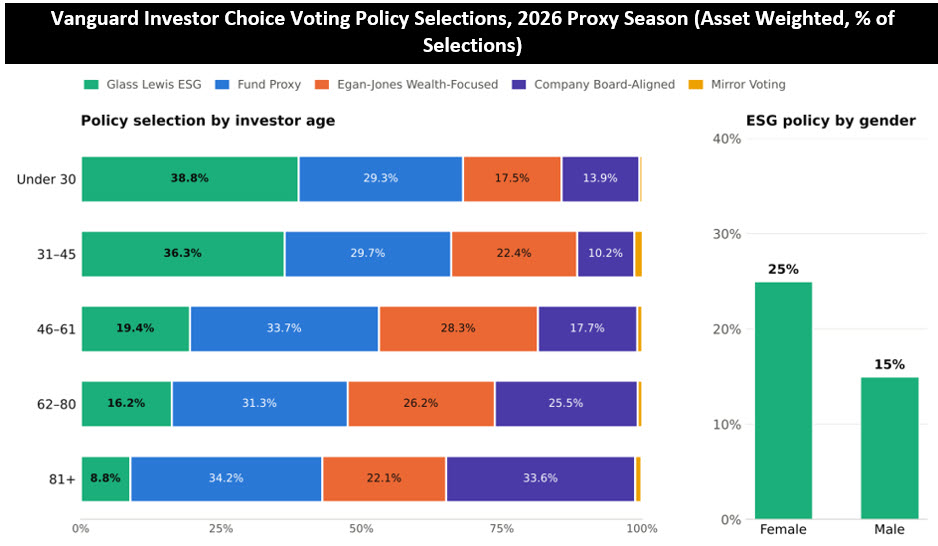
Notes of Explanation: Vanguard Brokerage clients, asset weighted. Mirror voting (yellow) ranges from 0.5% to 1.5% across age groups. Segments may not add to 100% due to rounding. Source: How Investors Vote-Vanguard’s annual Investor Choice policy selection and participation report, September 2026.
Observations:
• Proxy voting choice program participation jumps more than sixfold. Vanguard launched Investor Choice as a pilot in 2023 to let investors in its index funds decide how their proportionate share of each fund’s holdings is voted at company meetings. Its 2026 How Investors Vote Report, released September 29, describes the program as the world’s largest retail proxy voting choice program. Participation jumped more than sixfold, from 82,000 investors in 2025 to 507,000 in 2026, while participating assets grew nearly 17-fold, from $9 billion to $151 billion. Nearly 80 retirement plan sponsors, representing more than 1 million plan participants, also took part, and some 22 million investors with roughly $4 trillion in assets are now eligible. Four other U.S. fund firms let fund shareholders choose how their shares are voted, including BlackRock, State Street, Schwab and Invesco. Only State Street comes close to Vanguard in how widely it’s open to ordinary investors.
• Which funds are covered. As of July 31, 2026, Investor Choice applied to 32 Vanguard equity index mutual funds and ETFs, across all share classes, plus seven collective investment trusts. The program reached 12 funds by mid-2025 and was extended twice to reach the number of funds offered today. Vanguard has committed to bringing all its U.S. equity index funds into the program in 2027, which would lift eligible assets to about $8.1 trillion (based on US$ as of September 30, 2026) and pull in its largest fund, Total Stock Market Index, which is not among the current 32. Investors have already pre-selected policies for $120 billion in assets tied to those funds.
• Covered funds includes the $13.4 billion Vanguard ESG U.S. Stock ETF (ESGV). The fund tracks the performance of the FTSE US All Cap Choice Index. Investing in large-, mid-, and small-capitalization U.S. stocks, the fund employs an ESG screening and exclusionary approach to stock selection on top of its pass along ESG proxy voting options described below. ESGV screens out companies involved in (1) Vices and sin stocks including adult entertainment, alcohol, tobacco, cannabis, and gambling, (2) Weapons: Chemical, biological, cluster munitions, landmines, nuclear weapons, conventional military weapons, and civilian firearms, (3) Energy and Power, including fossil fuels (coal, oil, and gas) and nuclear power, as well as Standards Violations, namely companies failing UN Global Compact principles on labor, human rights, the environment, anti-corruption, or diversity criteria.
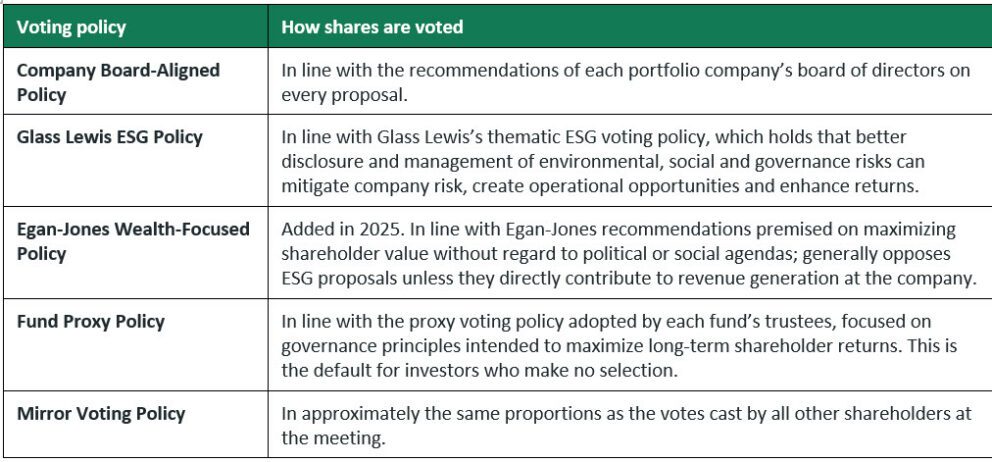
• Five ways to vote. Eligible investors can choose among five voting policies; those who make no selection continue to have their shares voted under the Fund Proxy Policy.
• ESG is the top pick for investors under 45. The Glass Lewis ESG Policy was the most popular option among investors under 30 (38.8%) and those aged 31–45 (36.3%), well ahead of the second-place Fund Proxy Policy (29.3% and 29.7%, respectively). It is the leading choice in no other age group. ESG selection falls sharply with age, to 19.4% for investors aged 46–61, 16.2% for those aged 62–80 and 8.8% for those 81 and older—so investors under 45 choose ESG at roughly twice the rate of those aged 46–80. Preferences mirror one another: the Company Board-Aligned Policy climbs from 13.9% among the youngest investors to 33.6% among the oldest, while the Egan-Jones Wealth-Focused Policy peaks at 28.3% among investors aged 46–61.
• A pronounced gender gap. Female investors selected the Glass Lewis ESG Policy at a 25% rate versus 15% for male investors—a 10-percentage-point gap that Vanguard describes as nearly twice the rate. Men made up about two-thirds (66%) of participants by headcount, which tilts aggregate results toward their preferences.
• Smaller accounts lean ESG, too. ESG selection declines steadily with account size, from 31% for balances under $100,000 to 14% for balances of $5 million or more. Because younger investors tend to hold smaller balances, the age and wealth effects overlap—and because Vanguard reports results on an asset-weighted basis, the headline figures likely understate how many individual investors are choosing ESG.
• The headline decline needs context. Across all eligible funds, the asset-weighted share of selections for the Glass Lewis ESG Policy fell to 12% in 2026 from 18% in 2025. The Company Board-Aligned Policy led with 38%, followed by Fund Proxy (28%), Egan-Jones Wealth-Focused (22%) and Mirror Voting (1%). Vanguard attributes the ESG decline largely to a shift in shareholder mix as broad-market and sector funds joined the program. Where ESG investors are concentrated, support is rising: in the ESG U.S. Stock ETF, a participant since 2023, selection of the ESG policy increased to 78% in 2026 from 73% in 2023, even as the number of policy choices expanded.
• Plan sponsors are steering clear of ESG. Retirement plan sponsors, who choose on behalf of participants, selected the Fund Proxy Policy for 84.9% of assets, Egan-Jones for 12.1% and Company Board-Aligned for 3.0%—and the ESG option for none. That pattern is consistent with plan fiduciaries’ caution amid ongoing legal and regulatory scrutiny of ESG considerations in retirement plans.
• Why it matters. As Investor Choice extends to roughly $8 trillion in assets in 2027 and wealth shifts toward younger generations, the pool of investors expressing ESG preferences through proxy votes could grow. At the same time, the results show no single policy commanding a majority, with substantial support for board-aligned and wealth-focused alternatives. As pass-through voting gains traction within Vanguard and beyond, the takeaway for asset managers, companies and proxy advisors is that the once-monolithic index fund vote could become fragmented into a more diverse, retail-driven electorate—one in which the youngest owners are the most likely to vote with ESG in mind. For a segment of sustainable investors, pass through proxy voting with an ESG option outside labeled sustainable funds offers an avenue to express their sustainability preferences while investing in conventional mutual funds and ETFs at a time when the number of labeled sustainable funds is shrinking.