


The Sustainable Bottom Line: The average ESG Rating calculated for the Dow Jones Industrial Average doesn’t change following the addition of Alphabet, Inc., effective yesterday.
Alphabet Inc. is replacing Verizon Communications as a constituent in the Dow Jones Industrial Average effective today, but its MSCI ESG Rating doesn’t change
On June 23, 2026 S&P Dow Jones Indices announced that Alphabet Inc. (GOOGL) will replace Verizon Communications Inc. (VZ) in the Dow Jones Industrial Average (DJIA) effective prior to the opening of trading yesterday (June 29, 2026). The addition brings a fifth member of the so-called Magnificent Seven group into the 30-stock benchmark, alongside Apple, Microsoft, Amazon, and Nvidia. From a sustainable investing point of view, the replacement of Verizon (AA MSCI ESG Rating) by Alphabet with its BBB ESG Rating by MSCI shifts the average ESG score of the DJIA slightly lower from 5.3 to 5.2, along a seven-point scale. This is based on MSCI’s ESG Ratings calculated by assuming equal weights assigned to the 30 stock holdings and their ESG Ratings*. Refer to the chart below that displays the distribution of the DJIA MSCI ESG ratings as well as the accompanying table at the end of the article. That said, the benchmark still retains its overall ESG Rating of A, equivalent to an “Average” ESG performer. As a result of this change, sustainable investors who employ an ESG integration approach to investing and who invest in or might be considering an investment in a DJIA tracking mutual fund or ETF, the constituent change should not affect their decision one way or another.
The DJIA is a price-weighted benchmark of 30 “blue-chip” US stocks, meaning that stocks in the DJIA with higher share prices are given greater weight in the calculation of the benchmark.
According to S&P Dow Jones Indices, Alphabet’s diversified technology and digital services portfolio spans advertising, cloud infrastructure, artificial intelligence, hardware, autonomous mobility, healthcare technology, and media distribution. Adding Alphabet will broaden and strengthen the DJIA’s exposure to these dynamic areas of the U.S. economy. Its larger market capitalization and share price, together with the breadth of its businesses, make it a more representative Communication Services constituent in the DJIA. Alphabet serves as the Communication Services sector representative, succeeding a legacy telecom player.
MSCI’s industry-relative letter ESG ratings are assigned along a seven-point scale that runs from AAA to CCC based on how well they manage these risks and opportunities relative to peers
MSCI, a global provider of securities market indices, portfolio risk analytics and ESG research and ratings, uses a rules-based methodology to identify industry leaders and laggards, assigning each company an industry-relative letter rating along a seven-point scale that runs from AAA to CCC based on how well they manage these risks and opportunities relative to peers. Firms rated AA and AAA are considered leaders in their industry in managing the most significant sustainability risks and opportunities. Firms rated BB, BBB and A possess a mixed or unexceptional record of managing the most significant sustainability risks and opportunities. Firms rated CCC and B are considered laggards in their industries based on their high exposure and failure to manage significant sustainable risks.
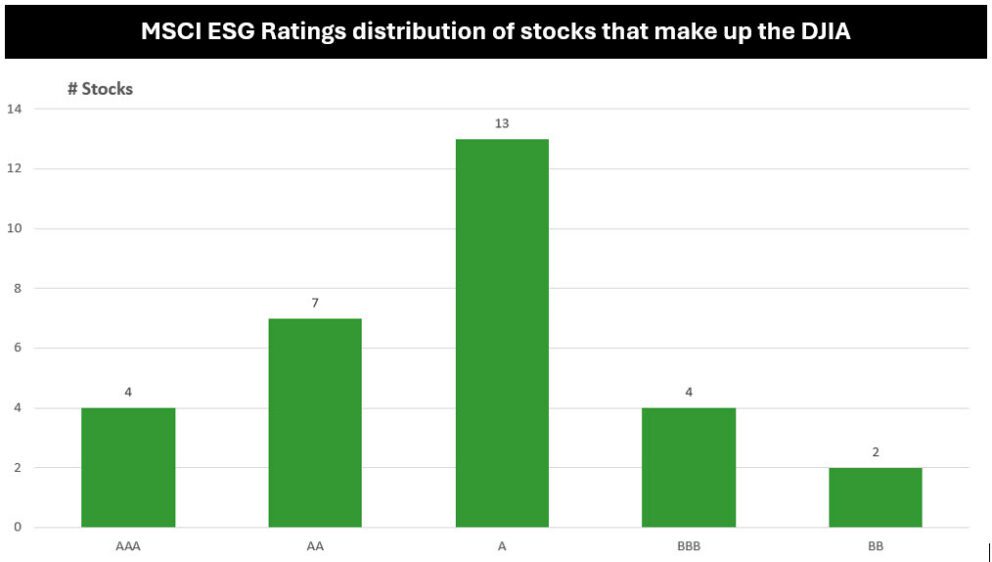 Notes of Explanation: Sources: MSCI and Sustainable Research and Analysis LLC
With its assigned ESG Rating of BBB to Alphabet Inc, the rating places Alphabet as an “Average” performer within the MSCI ESG framework. The company sits in the middle of the pack globally, failing to reach “Leader” status (AAA/AA) but avoiding the “Laggard” category (B/CCC). The following factors contributed to or detracted from the Alphabet company’s ESG Rating:
• Environmental (Strong Performer). The environmental pillar is Alphabet’s strongest area, driven by heavy investments in green infrastructure:
-Carbon Neutrality: Alphabet has maintained operational carbon neutrality since 2007 through carbon offsets.
-Clean Energy Initiatives: It is one of the largest corporate purchasers of renewable energy, pushing toward carbon-free energy 24/7 across all data centers.
-Efficiency: Its custom-built data centers are heavily optimized, using roughly 50% less energy than a standard enterprise data center.
• Social (Laggard to Average). The social pillar represents a major risk area that drags down Alphabet’s overall score:
-Data Privacy & Security: This is Alphabet’s most critical vulnerability. Constant scrutiny over consumer tracking, data collection, and targeted advertising lowers its score.
-Workforce & Culture: While offering top-tier compensation, Alphabet faces periodic internal friction regarding workforce diversity, handling of sexual misconduct allegations, and contractor rights.
-Content Moderation: YouTube faces ongoing social pressure and regulatory threats regarding misinformation, radicalization, and child safety.
• Governance (Average). Alphabet’s governance score is a mixed bag of robust corporate structures and high-profile legal issues:
-Dual-Class Stock: The company uses a multi-class share structure (Class B shares hold super-voting rights). This keeps voting power concentrated with the founders, which MSCI and institutional investors generally view as a negative for minority shareholder rights.
-Antitrust & Anti-Competition: Ongoing Department of Justice (DOJ) lawsuits and European Union regulatory fines regarding search dominance and advertising monopolies create constant governance risks.
In addition, to the admission of Alphabet, Inc., DJIA constituent Honeywell International Inc. (NASD:HON) is spinning off Honeywell Aerospace Inc. (NASD:HONA) in a transaction expected to be completed today (June 29, 2026). Post spin-off, the Honeywell parent will remain in the DJIA under the new name Honeywell Technologies Inc. Honeywell Aerospace will not be included in the DJIA. For purposes of calculating the updated DJIA’s ESG Rating, it was assumed that Honeywell Technologies, Inc will retain its AA ESG Rating.
Dow Jones Industrial Average index tracking fund investing options
Sustainable investors pursuing an ESG integration approach to investing engage in the widely practiced (some data suggests the most widely practiced) investment approach by which environmental, social and governance factors and risks are systematically analyzed and, when these factors are deemed financially relevant and material to an entity’s performance, they will influence decisions on whether to buy or hold a security, and to what extent. Together with any other investment-related considerations applicable in actively managed portfolios, the analysis may also lead to the sale of a security from the portfolio. MSCI’s ESG Ratings inform the implementation of an ESG integration approach to investing and, in passively managed portfolios, these ratings serve as a basis for establishing eligibility criteria. The “Average” rating achieved by the DJIA and the absence of companies in the “Laggard” category offer sustainable investors a basis for investing in a DJIA index tracking fund.
A labeled sustainable DJIA tracking fund, one that explicitly refers to ESG related factors in the fund’s offering documents, is not available currently. That said, sustainable investors interested in a DJIA tracking fund have two conventional DJIA tracking funds to choose from. These include the $43 million State Street SPDR Dow Jones Industrial Average ETF Trust (DIA) that is subject to a low 0.16% expense ratio. While the fund has been in operation since January 1998, it has operated as a Unit Investment Trust until February of this year. The second fund is the small $21.5 million Rydex Dow Jones Industrial Average, advised by Guggenheim Investments, and offering share classes A, C and H. The share classes are subject to above average expense ratios of 1.61%, 2.36% and 1.61%, respectively. When considering the two options, investors may be guided by the funds’ performance track records, their expense ratios, and fund sizes, which are presented in the table below.
*Based on an average weighted price calculation using closing prices on June 29, 2026, the average weighted ESG Rating score is also 5.2, or an "Average" ESG Rating.
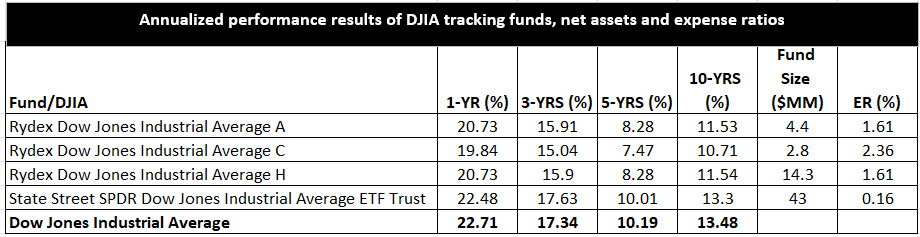 Notes of Explanation: Performance results are to May 31, 2026. 3-5 and 10-year results are average annual. Sources: Morningstar, fund prospectuses and SAIs and Sustainable Research and Analysis LLC.
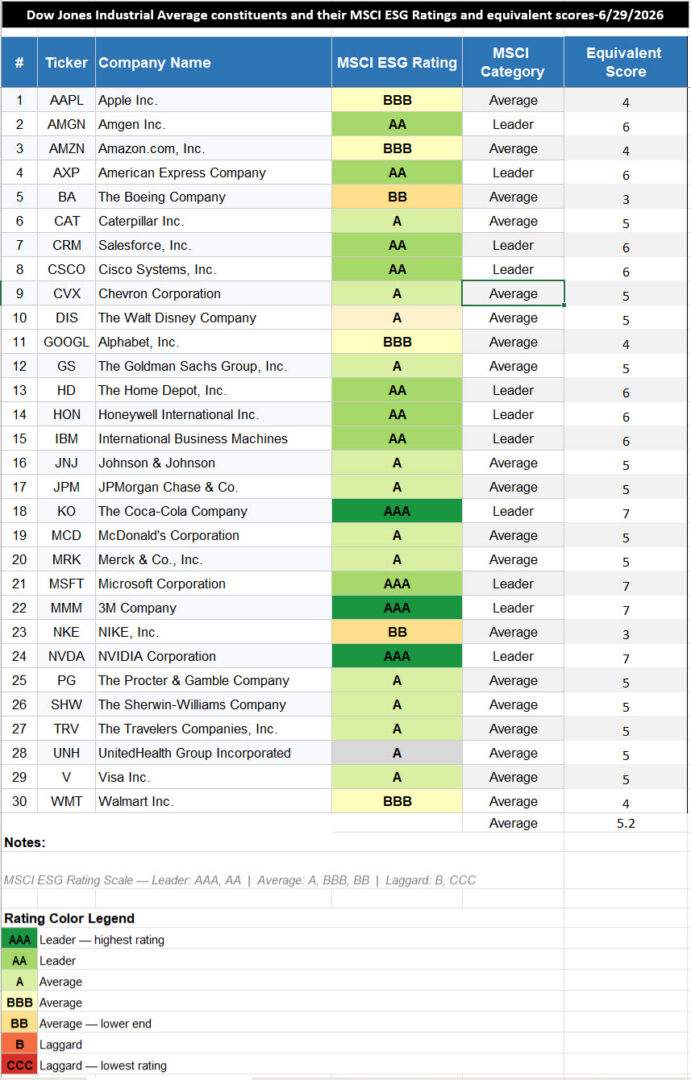 Notes of Explanation: The new name of Honeywell International is Honeywell Technologies Inc. Sources: MSCI and Sustainable Research and Analysis LLC.