Observations:
• The top ten performing labeled sustainable mutual funds and ETFs in July posted an average gain of 4.9%, ranging from +3.76% to +6.29% in a month when both the S&P 500 (-0.60%) and the Bloomberg US Aggregate Bond Index (-1.30%) declined. These top performing funds led the 337 funds/share classes that posted positive returns in July, or just 34%, of the 998 long-term sustainable funds/share classes listed at the end of July. The same top performing funds were up an average of 9.6% over the trailing twelve months, ranging from -2.92% to 26.27%.
• The common thread across nearly all ten funds is that July pointed to a market rotation away from the AI-and-semiconductor trade that had powered the broad market for nearly three years, and toward value, financials, dividend payers, and non-US equities. Funds that were underweight or largely absent from mega-cap chip names, whether through quality/value security selection (Calvert, Boston Trust) or because a thematic or climate mandate simply pointed the portfolio elsewhere (JHancock, KraneShares), were positioned to benefit, while two funds (the China clean-tech ETF and the bitcoin/carbon-credit ETF) caught idiosyncratic rebounds in their respective asset classes.
• Energy was also one of the strongest-performing sectors globally in July (leading European markets in particular), but that tailwind is largely unrelated to this group’s sustainability mandates rather than a product of them. Most of these funds carry little to no energy exposure, and a hard fossil-fuel exclusion, where one exists, as at JHancock Global Climate Action, would if anything have been a mild headwind in a month when energy rallied, not an advantage. The one fund in the group with a meaningful energy position, Impact Shares Women’s Empowerment ETF (via a top-10 holding in Exxon Mobil), benefited from July’s energy strength directly rather than by avoiding it. The connective link across the group is therefore avoidance of the AI/semiconductor drawdown, not fossil-fuel exclusion. Payments networks (Visa, Mastercard) and diversified mega-cap technology names ex-semiconductors (Microsoft, Apple, Alphabet) were the most common holdings linking the group, appearing across three or more of the ten portfolios.
• Landing as the top performing fund in July, the Calvert Equity Fund I (CEYIX) gained 6.29% during the month but it lagged over the trailing twelve-month interval with a -2.92% return. Calvert Equity’s top-10 holdings, Mastercard, Visa, Thermo Fisher Scientific, Danaher, VeriSign, Alphabet, Microsoft, TJX, and Verisk, carry essentially no exposure to Nvidia or Apple, two names commonly identified with the AI/semiconductor trade. That positioning was a drag over the trailing twelve months (hence the -2.92% one-year return, which lagged a market led by chip stocks) but became the fund’s single biggest advantage in July, when capital rotated directly out of the names Calvert never held and into the quality/payments names it does.
• Closely behind Calvert is the $1.5 million 7RCC Spot Bitcoin and Carbon Credit Futures ETF (BTCK), up 6.10%. Launched on June 4, 2026, this is only the second newly listed fund so far this year. The fund tracks the 7RCC Kaiko Bitcoin Carbon Credit Index, a systematic 80% spot bitcoin/20% regulated carbon-credit-futures allocation (European Union Emissions Trading System, California Cap-and-Trade Program/ California Carbon Allowances and the Regional Greenhouse Gas Initiative, a cooperative effort among Eastern U.S. states, including New York, Massachusetts, and Maryland). Both legs contributed in July: bitcoin rebounded roughly 9.8% for the month after two consecutive down months (down 20.5% in June alone), and EU carbon allowances firmed to roughly €82/tonne on reform and supply-tightening expectations.
• While each of the funds share a common sustainable label, their approach involved meaningfully different methodologies. Two long-tenured responsible-investing managers (Calvert and Boston Trust Walden, which runs both the Boston Trust Equity and Boston Trust Asset Management funds) build broad ESG-integrated portfolios and back them with decades of active-ownership and shareholder-engagement work. Several others are narrower, single-theme vehicles built around one specific issue: climate alignment (JHancock), Chinese clean-technology revenue (KraneShares), gender equality (Impact Shares), or a blended digital-asset/carbon-credit structure (7RCC). The remainder sit in between, integrating material ESG factors and, in some cases, applying exclusionary screens on top of otherwise conventional fundamental or quantitative security selection (MFG, Thornburg, USCF).



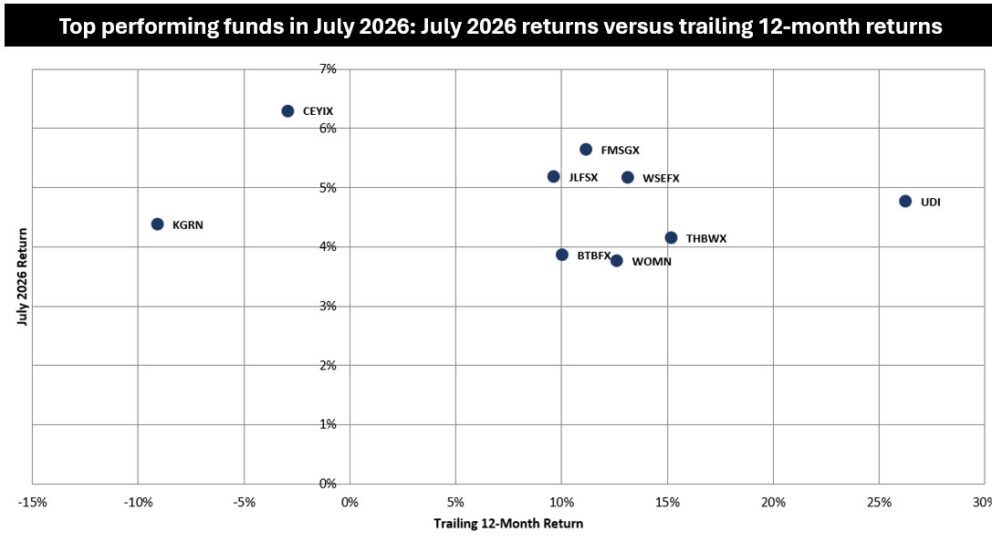 Notes of Explanation: Notes of Explanation: Chart only covers funds in operation for the trailing 12 months. BTCK, which has not been in operation for 12 months, is not displayed in the chart. The top 10 performing funds (%) in July are; Calvert Equity I (CEYIX) 6.29, -2.92; 7RCC Spot Bitcoin & Regulated Carbon Credits Futures ETF (BTCK) 6.1; MFG Global Sustainable Service (FMSRX) 5.64, 11.17; JHancock Global Climate Action I (JLFSX) 5.18, 9.66; Boston Trust Equity (BTEFX) 5.16, 13.13; USCF Dividend Income ETF (UDI) 4.76, 26.27; KraneShares MSCI China Clean Tech ETF (KGRN) 4.38, -9.08; Thornburg Better World International A (TBWAX) 4.15, 15.19; Boston Trust Asset Management (BTBFX) 3.86, 10.04; and Impact Shares Women’s Empowerment ETF (WOMN) 3.76, 2.62. Sources: Morningstar and Sustainable Research and Analysis LLC.