Observations:
• Labeled sustainable mutual funds and ETFs posted an average gain of 0.52% in June and 19.5% over the trailing 12-months versus gains for the narrower segment of U.S. Equity funds that added an average of 1.70% and 21.2%, respectively. At the same time, Small Blend funds (9 funds), Small Value funds (1 fund), and, to a lesser degree, Small Growth funds (1 fund), turned in the strongest performance results during the two-time intervals. These three investment categories combined recorded average returns in June of 7.03%, 1.62% and 5.88% and, from July 1, 2025, average gains of 26.03%, 28.50% and 31.95%, respectively.
• Investor sentiment favoring small-cap stocks and funds, that began as early as November of 2025, can be attributed, in large part, to cheap relative valuations, accelerating earnings growth, a broadening of AI-related capital spending into smaller suppliers and a market rotation away from concentrated mega-cap tech into cyclical and domestic sectors, such as financials, energy and industrials.
• Within the small-cap universe, value stocks outperformed growth stocks, and the value tilt can be observed in the divergence of performance across the limited universe of labeled sustainable small cap funds. The universe of small caps consists of just 11 actively and passively managed mutual funds and ETFs and 20 share classes that are dominated by nine blended funds. The best performing fund over the previous 12 months is the Impax Small Cap Fund I shares. The fund, up 42.9%, finished the twelve-month interval as the single best performer due to successful stock selection that overcame a zero allocation to the Energy sector. At the other end of the range is the Calvert Small Cap Fund R6, up just 5.2% versus the next lowest performer at 14.4%, due, it seems, to weak bottom-up stock selection within Calvert’s active, engagement-oriented responsible investing process.
• The sustainable investing approaches across the small cap segment vary. These fall into roughly five distinct approaches to sustainable investing: (1) Systematic factor tilt with sustainability adjustment (DFA): The fund starts from a value/profitability factor process and adjusts individual company weights for GHG emissions intensity, fossil fuel reserves, and other exclusionary criteria. (2) Thematic transition/impact investing (Impax): The fund selects companies positioned to benefit from the transition to a more sustainable economy, with bottom-up ESG integration. (3) Quality-and-exclusion active management (Kennedy Capital, Boston Trust Walden, Brown Advisory): These funds combine fundamental quality or valuation discipline with ESG inclusion/exclusion criteria (e.g., fossil-fuel-free, tobacco/weapons exclusions). (4) Responsible investing with engagement (Calvert): The fund applies Calvert Principles ESG criteria plus active company engagement across a broad, diversified small-cap portfolio. (5) Rules-based index/ESG-screened passive (iShares, Nuveen, Praxis): The funds apply either an optimization overlay, sector-relative ESG scoring, or category-specific (including faith-based) exclusions to a broad small-cap benchmark, with varying degrees of tracking difference from that benchmark.
• Given the limited number of labeled sustainable small cap investing options and, in particular, Small Value options, sustainable investors interested in exploring alternative small cap value fund offerings outside the labeled funds universe, can seek out investment management firms that formally employ an ESG integration approach across their active equity management platforms (This is an explicit financially material-factor-driven process for making investment decisions). While exclusions are not part of this approach, varying levels of ESG-related engagement and proxy voting practices are not uncommon among the largest firms. A good starting point to begin the search for such firms includes BlackRock, Federated Hermes and Nuveen. These firms receive high scores for their stewardship and disclosure practices by Sustainable Research and Analysis LLC.


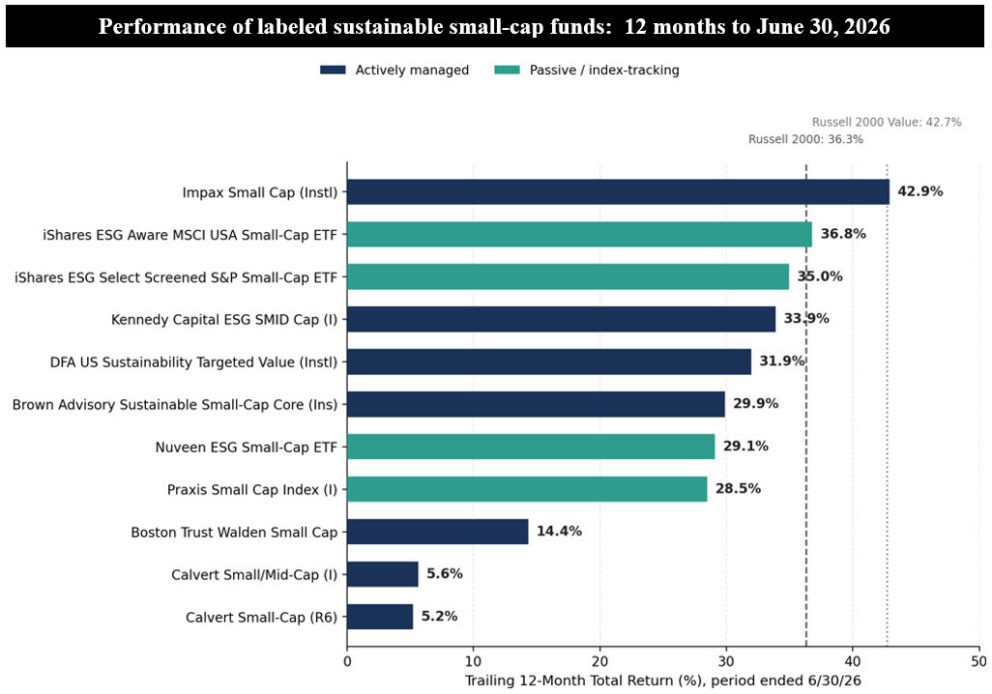 Notes of Explanation: Chart displays funds that comprise Small Blend funds (9 funds), Small Growth funds (comprised of just one fund–Calvert Small/Mid-Cap) and Small Value funds (also comprised of just one fund–DFA US Sustainability Targeted Value Institutional) funds, excluding any funds with a thematic orientation. In the case of mutual funds with multiple share classes, the share class posting the highest return, usually subject to the lowest expense ratio, is listed. Data to June 30, 2026. Sources: Morningstar and Sustainable Research and Analysis LLC.