Observations:
•The 10 largest labeled sustainable taxable bond funds as of June 30, 2026 managed some $30.8 billion in net assets, accounting for 58.3% of the taxable bond segment’s $52.8 billion as of the same date. The same 10 funds managed $28.6 billion at the start of the year, adding $2.2 billion during a period when taxable bond funds posted an average gain of 0.9%. The biggest winner during the six-month interval is the Nuveen Core Impact Bond Fund. The fund, which added $895.2 million or 41% of the net asset gains attributed to the 10 largest funds, is also the largest labeled sustainable taxable fixed income fund.
• Managed by seven firms, the largest funds combine active management and an indexing approach that are further differentiated based on expense ratios. The six actively managed funds carry an average expense ratio of 0.62%, ranging from 0.35% levied by the Nuveen Core Impact Bond R6 (TSBIX) to 1.45% attributed to PIMCO Total Return ESG Institutional (PTSAX) while the four index funds, all ETFs, charge an average expense ratio of 0.13% ranging from 0.1% charged by iShares ESG US Aggregate Bond ETF (EAGG) to 0.18% passed on by iShares ESG USD Corporate Bond ETF (SUSC). In the case of mutual funds, the expense ratios are attributed to largest share class based on net assets as of June 30.
• The investment strategy mandates of the ten firms vary and include: active and passively managed core bond funds, core-plus bond funds, an investment-grade intermediate duration fund investing primarily in agency and government-backed securitized bonds, short duration credit and corporate bond funds and a U.S. investment grade corporate bond fund.
• The funds also take markedly different routes to “sustainable” fixed income. Broadly, they fall into four groups: impact/use-of-proceeds funds that target measurable social or environmental outcomes (Nuveen Core Impact Bond, CCM Community Impact Bond (CRNAX), and Praxis Impact Bond (MIIIX) with a faith-based overlay; actively managed ESG-integration funds that combine ESG risk analysis, exclusions and issuer engagement within an otherwise conventional active bond process (two Calvert funds, including Calvert Bond (CBDIX) and Calvert Short Duration Income (CDSIX) as well as the PIMCO Total Return ESG Fund); and passive “ESG-aware” index ETFs that tilt toward higher-ESG rated issuers while tracking a benchmark’s risk/return profile closely (iShares ESG US Aggregate Bond Fund, iShares ESG USD Corporate Bond and iShares ESG 1-5 Year USD Corporate Bond (SUSB)), versus a passive exclusionary/SRI index ETF that screen out entire industries (Vanguard ESG U.S. Corporate Bond (VCEB)).
• Investors should look past the “ESG” or “impact” label to the underlying methodology, since these approaches can produce meaningfully different sector exposures, credit profiles and performance patterns relative to conventional bond benchmarks.



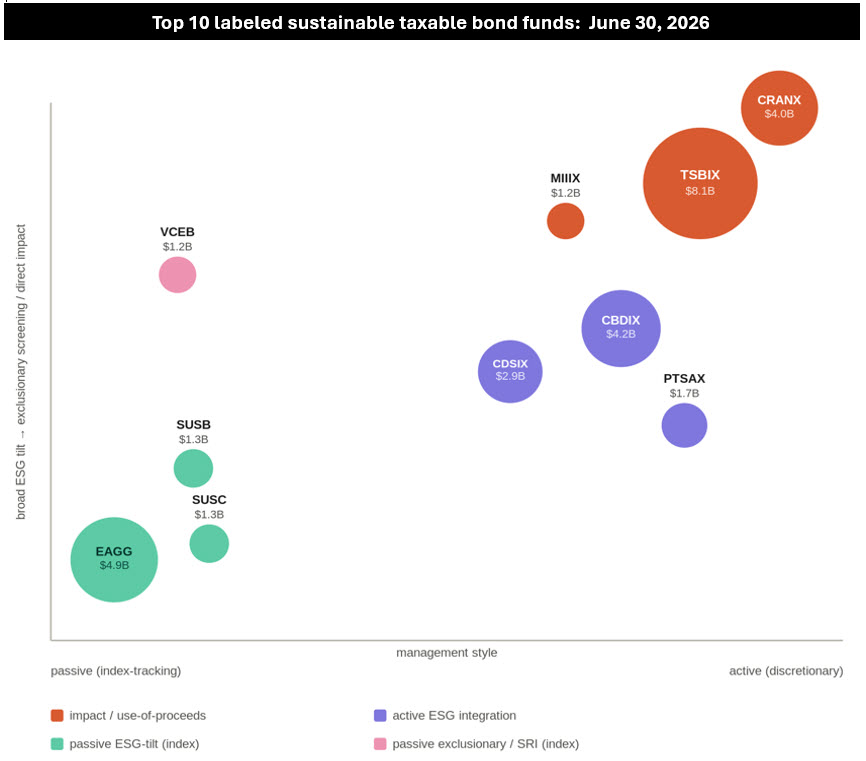 Notes of Explanation: Bubble size = $AUM as of June 30, 2026, which in the case of mutual funds combines all share classes. Also in the case of mutual funds, ticker symbols apply to the largest share class, for example, in the case of Nuveen Core Impact Bond Fund, the largest share class is R6, TSBIX, with $5.6 billion in assets. In the Observations below, ticker symbols are only references once. Bubble positioning is qualitative, illustrative positioning based on the fund’s strategy. Sources: Morningstar, public fund filings and related document and Sustainable Research and Analysis LLC.