

The Bottom Line: Extraordinary returns delivered over the trailing 12-months versus results in February reveals a divide between commodity-linked funds and pure-play clean energy funds.
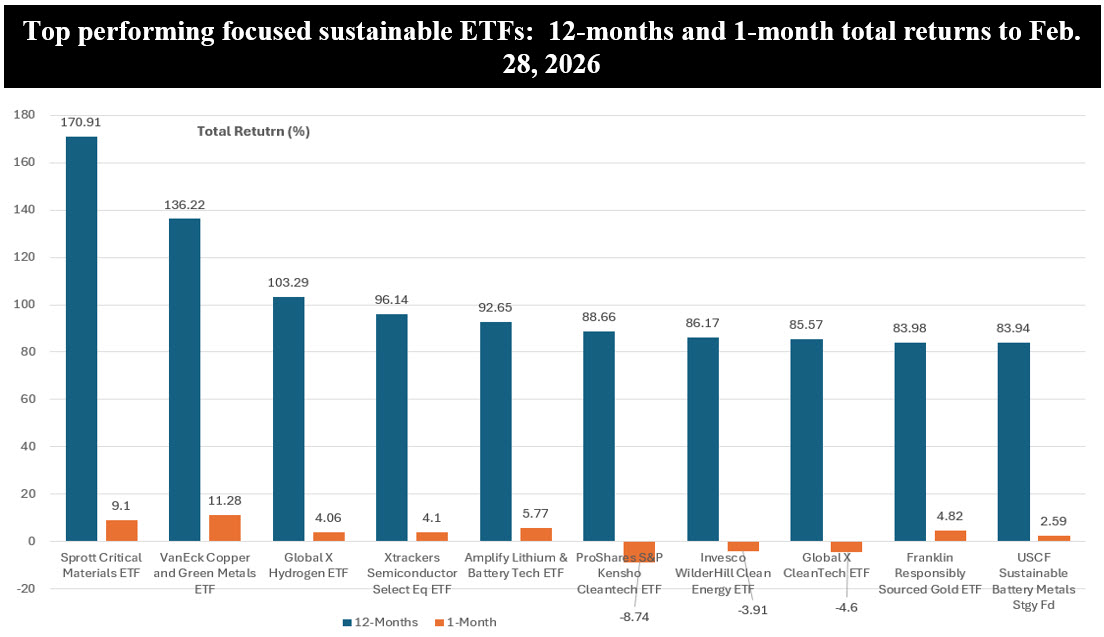
Notes of Explanation: Funds listed in descending order based on trailing 12-month performance results to February 28, 2026. In the case of mutual funds, only the best performing share class is displayed. Sources: Morningstar, Sustainable Research and Analysis LLC.
Observations:
• Spanning the intersection of the global energy transition, critical minerals supply chains and next generation technology infrastructure, the top 10 performing thematic sustainable ETFs, based on their trailing 12-month results through the end of February, delivered extraordinary returns. Averaging a gain of 102.8%, the same funds recorded returns that ranged from 84% to 171%. February 2026, however, revealed a sharp split between winners and losers. Averaging 2.45% in February, results registered by the same ten funds ranged from a low of -8.74% to a high of 11.28%. Three funds recorded negative returns.
• February’s winners were commodity-linked funds, including VanEck Copper (+11.28%), Sprott Critical Materials (+9.10%), and Franklin Responsibly Sourced Gold (+4.82%), whose results were driven by physical supply tightness and safe-haven demand.
• February losers, on the other hand, were clean energy equity funds, including ProShares Kensho Cleantech (-8.74%), Global X CleanTech (-4.60%), and Invesco WilderHill (-3.91%). These funds were weighed down by policy uncertainty and rate sensitivity.
• Of the top 10 funds, only two funds employ a sustainable investing overlay, including Franklin Responsibly Sourced Gold ETF (FGDL) and USCF Sustainable Battery Metals Strategy Fund (ZSB). FGDL integrates ESG principles directly into its investment approach, holding only physical gold sourced from the London Bullion Market Association (LBMA) accredited refiners. The LBMA’s responsible sourcing program mandates that refiners demonstrate efforts to protect the global environment, combat money laundering and terrorist financing, and uphold human rights. Only gold refined after January 1, 2012 and meeting these ethical criteria is eligible for inclusion. This is the only fund in the group with a formal, auditable supply chain standard baked into its mandate. As for ZSB, an important component of the fund’s sustainable strategy is that it seeks to achieve a “net-zero” carbon footprint by purchasing carbon offset investments in an amount equal to the estimated aggregate carbon emissions of the fund’s holdings. It also invests in securities of companies that directly promote environmental responsibility. The net-zero carbon offset commitment is notable and distinguishes it from peers, though the robustness of the offsets themselves is worth scrutinizing.
• Going forward, key risks faced by these funds include policy uncertainties due to further potential Inflation Reduction Act (IRA) reversals or modifications, China demand slowdown, commodity price volatility, valuation risks following massive run ups, geopolitical supply chain disruptions, interest rate sensitivity and the classic competitive dynamics in semiconductors that includes exposure to semiconductor cycle risk.