

Sustainable Bottom Line: Sustainable Bottom Line: Only 9% of labeled sustainable funds across 13 categories beat benchmarks in all three periods; low costs often separated leaders from laggards.
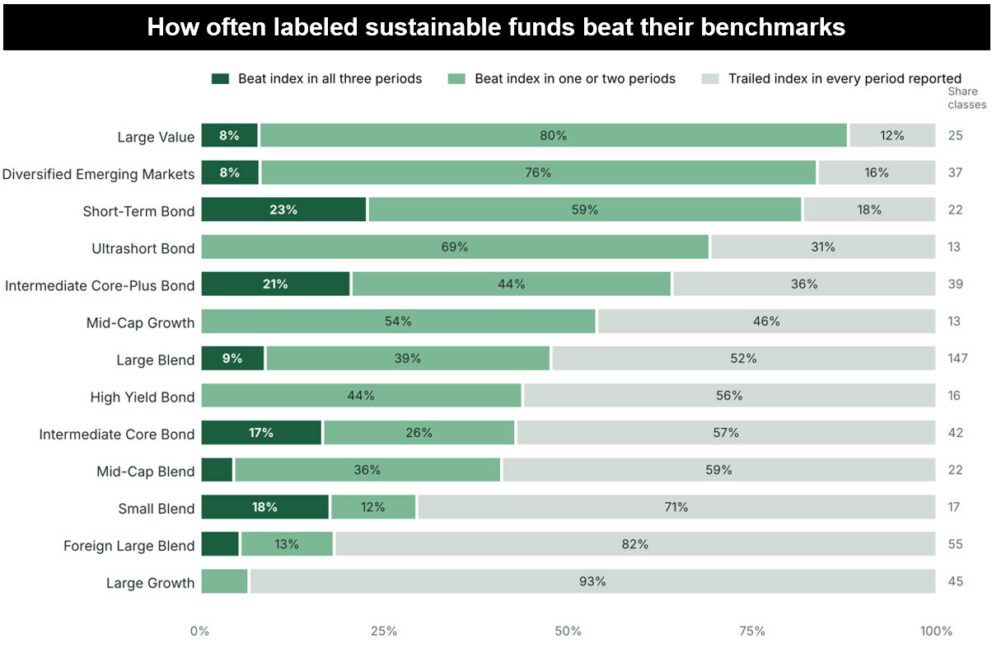
Notes of Explanation: Share of share classes in each category, by number of periods (1, 3 and 5 years), matching or beating the comparison index, based on data to September 30, 2026. Comparison indices may not correspond to the indices used in fund prospectuses and annual shareholder reports based on the SEC’s requirements. Sources: Morningstar and Sustainable Research and Analysis LLP.
Observations:
Summary
Our third-quarter update of the Sustainable Fund Quality Scores covers 494 labeled sustainable fund share classes (493 of them scored), with $323 billion in net assets, across 13 categories consisting of active and passively managed funds that may be used as building blocks in crafting sustainable short-to-intermediate and long-term investment portfolios (1). These consist of eight equity categories, from large-cap U.S. to emerging markets, and five taxable bond categories, from ultrashort to high yield—each one comprised of at least five or more mutual funds plus their share classes and ETFs. The update does not apply to investment categories that cover thematic funds.
The universe of labeled sustainable mutual funds and ETFs is small, and it continues to shrink due to liquidations, re-brandings and reclassifications while at the same time there have been almost no new fund listings. At the end of September, there were 972 labeled sustainable long-term funds/share classes with $392.2 billion in net assets that covered 70 long-term investment categories (excluding money market funds) based on Morningstar’s classifications (1). Of these, a subset of 493 funds and their scores are covered in this article. The subset is restricted to investment categories with at least 5 funds, either mutual funds or ETFs that qualify as building blocks in crafting sustainable short, intermediate and long-term investment portfolios consisting of funds (2).
• Just 45 of the 493 of scored funds/share classes (9%) matched or beat their comparison index over one, three and five years, down from 67 in the second quarter.
• Large Value, Diversified Emerging Markets and Short-Term Bond funds outperformed most broadly; Large Growth and Foreign Large Blend lagged almost across the board.
• Seven in ten share classes kept the same quality score from Q2. Most of the movement came from shifting index returns rather than from the funds themselves.
• Thirteen share classes earned a perfect 100 points, and most of them are low-cost index ETFs or institutional share classes.
Q3 results: beating the benchmark is the exception
Sustainable funds found it hard to keep pace with their benchmarks. As the chart shows, just 45 share classes (9%) matched or beat their category index in all three periods, while 259 (53%) trailed in every period they reported. The five-year period was the hardest test: only 76 of the 384 share classes with a five-year record (20%) cleared it.
Results varied widely by category. Large Value funds beat the S&P 500 Value broadly: 20 of 25 did so over one year. Diversified Emerging Markets and Short-Term Bond funds were also strong. At the other end, 42 of 45 Large Growth share classes and 45 of 55 Foreign Large Blend share classes trailed their indices in every period. In those categories, expense ratios did most of the work in sorting funds into tiers.
What changed since Q2
Scores were largely stable: 340 of 488 share classes scored in both quarters (70%) kept the same tier, 77 moved up and 71 moved down. The bigger shift was in the benchmarks. As the one-year window rolled forward, trailing one-year index returns fell sharply: the Russell 2000 from 40.8% to 16.2%, MSCI EM from 43.5% to 29.2% and the S&P MidCap 400 from 25.9% to 11.7%. Because performance points are all-or-nothing, funds close to their index line were the most likely to change tiers. Short-Term Bond funds beating their index in all three periods fell from 15 to 5. Small Blend was the only category in which no score changed.
Fourteen share classes left the universe, and ten at Ashmore, AMG GW&K and Cromwell dropped “ESG” or “Sustainable” from their names.
Highest-scoring funds
Thirteen share classes earned a perfect 100 points. These include Xtrackers MSCI Emerging Markets Select ETF (EMCS); iShares ESG MSCI USA Leaders (SUSL), Xtrackers MSCI USA Selection Equity (USSG) and Fidelity U.S. Sustainability Index (FITLX) in Large Blend; PIMCO RAFI ESG US ETF (RAFE) in Large Value; and Nuveen’s Core and Impact, Green Bond and Short Duration and Impact bond funds. Consistency stands out as well: the Calvert International Responsible Index, Neuberger Quality Equity and Impax Small Cap share classes scored A in both quarters and beat their indices in all three periods this quarter.
How the scores work
Sustainable Fund Quality Scores are computed and updated on a calendar quarter basis for mutual funds, including share classes, as well as ETFs that (1) are classified as labeled sustainable long-term funds (excluding money market funds) by Morningstar, and (2) fall into investment categories comprised of at least five or more mutual funds and ETFs. Each fund and share class earns 30, 50 and 20 performance points for matching or beating its category index over one, three and five years. Comparison indices may not correspond to the indices used in fund prospectuses and annual shareholder reports based on SEC’s requirements. Indices have been selected by Sustainable Research and Analysis (SRA) to represent the broad U.S. taxable conventional bond market or, as appropriate, narrowly based conventional indices. Expense ratios are also considered. Each fund’s expense ratio earns 25 to 100 cost points based on its quartile ranking within the investment category. Combined points weight performance 80% and cost 20%. Share classes are then ranked within each investment category: the highest scoring 15% are assigned a letter designation of A (Excellent), followed by the next high scoring 20% that receive a letter designation of B (Good), followed by the next average scoring 30% that receive a letter designation of C (Average), followed by the next below average scoring 20% that receive a letter designation of D (Below Average) and finally, the lowest 15% that receive a letter designation of E (Poor). Funds without a one-year performance record are listed but not scored.
Before making final investment decisions, several qualitative screening factors should be considered, including management company considerations, length of track record and fund size. Some investment categories may include a small number of funds that pursue a thematic approach. This factor should also be accounted for when reviewing scoring results. (updated 10/26).
Funds assigned Excellent to Good scores are deemed to be strong candidates in crafting short-to-intermediate and long-term investment portfolios or for investing on a standalone basis.
(1) The 972 funds/share classes collapse to 254 mutual funds and 178 ETFs.
(2) Investors with sustainable investing preferences that favor actively managed funds advised by investment firms that take into account financially relevant and material environmental, social and governance factors in investment decisions can take advantage of a broader universe of available mutual funds and ETFs, beyond labeled funds, commonly referred to as an ESG integration approach to sustainable investing. This is especially relevant in connection with labeled sustainable fund categories that are comprised of a very limited number of investment options and exposure to managers. For example, there are only 2 labeled small cap growth fund offerings available to investors, and one of these is a thematic fund; and there is only one small cap value fund listed. For some sustainable investors, this means that these investment styles are not available for use in crafting investment portfolios. That said, there are conventional funds that could expand the sustainable investing universe of funds for certain sustainable investors, in particular the large swath of sustainable investors who favor an ESG integration approach. A firm like J.P. Morgan Investment Management Inc. manages the JPMorgan Small Cap Growth Fund. The fund is not classified by Morningstar as a labeled sustainable fund, yet it is explicitly disclosed in the fund's Prospectus that “as part of its investment process, the adviser seeks to assess the impact of environmental, social and governance (ESG) factors on many issuers in the universe in which the Fund may invest. The adviser’s assessment is based on an analysis of key opportunities and risks across industries to seek to identify financially material issues with respect to the Fund’s investments in securities and ascertain key issues that merit engagement with issuers. These assessments may not be conclusive and securities of issuers that may be negatively impacted by such factors may be purchased and retained by the Fund while the Fund may divest or not invest in securities of issuers that may be positively impacted by such factors.” Furthermore, J.P. Morgan makes similar representations in its Stewardship reports. Other firms also fall into this category.