


Sustainable Bottom Line: Fed hike and surging yields sank seven of eight sustainable fund categories in September, while bond funds sit underwater across 12 months.
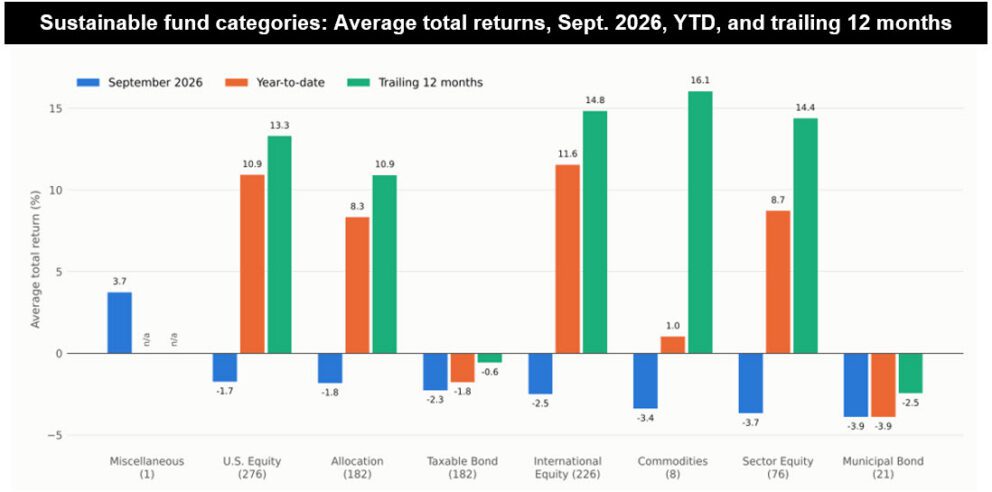
Notes of Explanation: Categories ordered by September returns. Number of funds/share classes in parentheses. Arithmetic (equal weighted) averages. Miscellaneous single fund constituent not in operation over YTD and trailing 12 month intervals. Data as of September 30, 2026. Sources: Morningstar and Sustainable Research and Analysis LLC.
Observations:
September was an unforgiving month for investors
September was an unforgiving month for investors generally, including labeled sustainable fund investors. Across 972 funds and share classes in eight categories (excluding money market funds), the average total return was -2.23%, and only 73 posted gains. Seven of the eight categories finished negative, ranging from an average -1.73% for U.S. equity to -3.89% for municipal bonds. The exception, Miscellaneous funds, a category consisting of a single fund. This is the recently launched very small $2.0 million 7RCC Spot Bitcoin and Carbon Credit Futures ETF (BTCK), which gained 3.74% as bitcoin rose about 8%.
Equity categories remain well ahead for the year. International equity leads year-to-date at 11.55%, followed by U.S. equity at 10.92%, while commodities lead over 12 months at 16.05%. Fixed income is the outlier. Taxable bond funds averaged -1.76% year-to-date and -0.57% over 12 months, and municipal bond funds -3.89% and -2.45%, making them the only categories posting negative returns across all three time periods.
Rates drove the sell-off
The Federal Reserve raised its target rate 25 basis points to 4.00% on September 16 to counter 3.4% inflation, and the 10-year Treasury yield jumped from 4.72% to about 5.28%. Bonds offered no cushion: average municipal fund losses exceeded those of every equity category. Rate-sensitive segments where sustainable funds tend to concentrate, including small- and mid-caps, dividend payers and clean energy, fell hardest, while large-cap technology rallied (Nasdaq-100 +3.3%). That helps explain why sustainable U.S. equity funds trailed the S&P 500 (-0.35%). A stronger dollar and a 6.3% drop in gold weighed on international and metals-oriented funds.
Narrow gaps between categories, wide gaps within them
Excluding Miscellaneous, category averages were just 2.2 percentage points apart in September, the signature of a market-wide sell-off rather than a rotation. Within categories, however, dispersion was extreme. Sector equity fund returns ranged from +10.36% to -14.75%, while allocation funds clustered tightly between -1.16% and -3.15%.
Fund standouts
Sector equity produced both extremes: Xtrackers Semiconductor Select Equity ETF (CHPS) gained 10.36% in September and 91.48% year-to-date, while Sprott Critical Materials ETF (SETM) gave up 14.75%. U.S. equity gainers were growth-oriented, led by Invesco ESG NASDAQ 100 ETF (QQMG) (+3.62%) and Parnassus Growth Equity I (PFPGX) (+2.36%); Invesco WilderHill Clean Energy ETF (PBW) (-7.27%) trailed, and all Calvert Equity share classes (CUBAX, CUBCX, CUBIX, CUBRX) are negative year-to-date. International equity was supported by emerging markets funds such as Xtrackers MSCI EMs Select ETF (EMCS) (+1.63%); Barrow Hanley Concentrated EM ESG Opportunities (BEOIX) is up 48.56% year-to-date, while climate funds like GMO Climate Change (GCCLX, GCCHX, GCCAX) (-7.7%) fell hardest.
Allocation results were reversed from a typical down month: bond-heavy conservative funds, based on the Calvert Conservative Allocation funds and Praxis Genesis Conservative Fund, lost about 2.5%, versus about 1.4% for Fidelity Sustainable Target Date 2060–2070 funds. In taxable bonds, every positive fund was a short-duration or floating-rate strategy, while Calvert Mortgage Access (CMMFIX, CMMCX, CMMIX, CMMRX) lost about 4%. Among municipal bonds, short-duration Fidelity SAI Sustainable Conservative Income Municipal Bond (FASYX) (-0.36%) is the only fund positive year-to-date. In commodities, Franklin Responsibly Sourced Gold ETF (FGDL) fell 8.48%, and iPath Series B Carbon ETN (GRN) (+3.13%) was the lone gainer.
Observations
• Only about 7.5% of labeled sustainable funds posted positive returns in September, and the lone positive category was a single small bitcoin and carbon credit fund.
• Rising rates hit stocks and bonds simultaneously, undermining the diversification investors expect from fixed income.
• Duration was decisive: the few bond funds that held up were short-duration or floating-rate strategies.
• “Sustainable” is not a single trade. Semiconductor, hydrogen and energy storage funds are far ahead of solar, EV and critical materials funds.