


Sustainable Bottom Line: The highest yielding labeled sustainable taxable bond funds posted 12-month trailing yields ranging from 5.8% to 9.8% and are expected to rise.
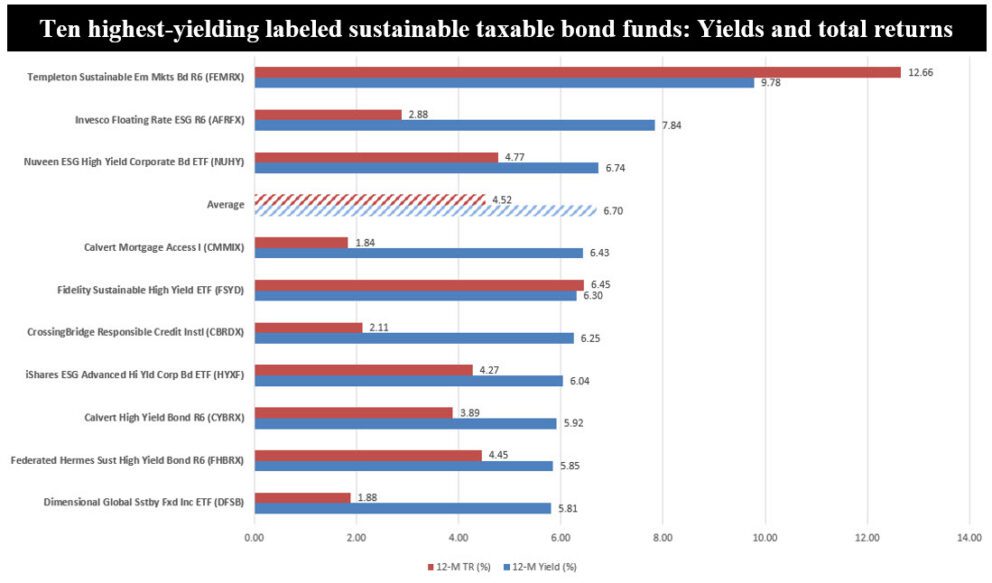
Notes of Explanation: Funds listed in order of trailing 12-month yields. In the case of mutual funds with multiple share classes, listing limited to highest yielding share class, typically charging the lowest expenses. Sources: Morningstar, Sustainable Research and Analysis LLC.
Observations:
• Rising yields that first closed above the 5% level for 10-year Treasuries on September 15, 2026 are, in turn, directing attention to fund yields that are expected to rise. The 10 highest-yielding labeled sustainable taxable bond funds recorded an average yield of 6.70% over the past twelve months, ranging from a low of 5.81% to a high of 9.8%–and with the Federal Reserve having just delivered its first rate increase in three years, yields are expected to rise further even as returns stay under some pressure (1). The ten funds posted an average total return of 4.5% over the same interval. While yields rose, bonds produced moderate to declining returns that in most cases offset or partially offset income payouts.
• The 10 funds, with nearly $3 billion in total net assets but dominated by five High Yield Bond funds with almost $1.5 billion in net assets or just about 50%, follow five broad investment strategies per Morningstar and fall into four sustainable investing approaches.
• Five of the 10 funds are classified as High Yield Bond funds, but the group also includes a Bank Loan fund, Securitized Bond-Diversified fund, a Multisector Bond fund and a Global Bond Fund-USD Hedged fund. That said, all but two of the funds maintain an average non-investment grade credit quality of B or BB. The two exceptions include the Dimensional Global Sustainability Fixed Income ETF (AAA) and the Calvert Mortgage Access Fund (BBB). Durations maintained by the group of 10 funds, based on their estimated effective duration, ranged from a low of 0.2 to a high of 6.8.
• Over the twelve months ending August 31, the Treasury curve rose roughly 65 to 80 basis points, while high yield spreads were range-bound and finished near 270 basis points, the tight end of their post-2008 range. That combination means the dispersion in this group’s total returns was driven overwhelmingly by where each fund sat on the curve, not by credit. Applying each fund’s effective duration to the rate move accounts for seven of the ten funds within less than a point. Calvert Mortgage Access, at 6.80, the longest duration in the group, lost 4.6 points to price against a 4.4-point duration-implied loss. Dimensional’s global mandate behaved the same way. The five high yield funds, clustered near three years of duration, gave back roughly two points each, almost exactly as predicted.
• Templeton Sustainable Emerging Markets Bond (FEMRX) is the only fund that posted a total return gain of 12.66%–in excess of its 9.78% yield. The fund is benchmarked to the J.P. Morgan GBI-EM Global Diversified index. Its return reflects emerging markets’ currency gains and local rates, a distinct engine from the rest of the list. At $24.2 million, it is also the smallest of the ten funds by a wide margin.
• Invesco Floating Rate ESG (AFRFX) posted the widest gap between its 7.84% yield and 2.88% return, almost attributable entirely to price movements. Leveraged loan markets saw genuine sector-level stress in 2026, with liability management exercises outpacing conventional defaults and visible pressure in concentrated sectors. A floating-rate fund is the one place on this list where the shortfall is telling you something about credit rather than about the curve.
• Calvert Mortgage Access (CMMIX) and Dimensional Global Sustainability Fixed Income (DFSB) sit at the other pole. Both are largely investment grade, and Calvert’s effective duration was 6.80 years at the end of June — the longest reported in the group. Both converted a 6%-ish yield into under 2% of total return.
• Fidelity Sustainable High Yield (FSYD) held the line, turning a 6.30% yield into a 6.45% return.
• Variations in the group’s investment strategies extends to the distinct approaches being used by the funds in implementing their sustainable investing approaches.
• Rules-based index screening (HYXF, NUHY). Sustainability is delegated to an index provider and the adviser has no discretion over constituents. iShares ESG Advanced High Yield runs the most extensive regime on the list: fourteen business-involvement screens covering adult entertainment, alcohol, civilian firearms, conventional and controversial weapons, for-profit prisons, fossil fuels, gambling, GMOs, nuclear power, nuclear weapons, palm oil, predatory lending and tobacco, plus exclusion of issuers with an ESG controversy score below 3 or an ESG rating below BB. Nuveen’s index is lighter-touch — ESG criteria plus low-carbon screening and exclusion of significant activity in controversial businesses, with sector weights adjusted to mirror the unscreened base index.
• Proprietary ESG ratings inside active credit selection (FSYD, CYBRX, FHBRX, CBRDX, AFRFX). Five of the ten build their own issuer-level assessment. Calvert applies its published Calvert Principles, scoring issuers peer-relative on material factors. Federated Hermes assigns a proprietary ESG rating and leans on EOS at Federated Hermes, its affiliated stewardship arm, for engagement. Fidelity pairs proprietary forward-looking and historical ESG frameworks with a multi-factor quant screen across more than 1,000 high yield bonds. CrossingBridge runs an exclusionary list first, including issuers not adhering to the UN Global Compact and OECD guidelines, then a proprietary engagement matrix with a minimum threshold. Invesco’s case is the most interesting: because senior loans are private instruments that ESG vendors barely cover, the firm scores each borrower 1 to 5 on E, S and G pillars from its own due-diligence calls with management, and states plainly that no peer comparison is available.
• Emissions-based tilting across corporates and sovereigns (DFSB). Dimensional excludes, underweights, overweights or neutral-weights issuers on greenhouse gas emissions, fossil fuel reserves, land use, biodiversity, controversies, waste and water, with categorical ineligibility for weapons, tobacco, palm oil, coal, private prisons and factory farming. Uniquely here, the framework reaches government debt: sovereigns are assessed on emissions per GDP with the highest emitters underweighted in aggregate, and agency and supranational issuers are screened on carbon intensity and potential emissions from reserves.
• Impact and outcome-oriented (CMMIX, and in a different way FEMRX). Calvert Mortgage Access is the only fund on the list where sustainability is defined by what the capital finances rather than by which issuers are screened out. It targets the U.S. homeownership gap, investing in mortgages made to underserved communities including minority, low-income and first-time borrowers. Templeton is a fourth variant again — it scores countries, not companies, and explicitly rewards improvement over absolute level, on the argument that snapshot ESG scoring systematically penalizes emerging markets. It excludes the worst performers in each ESG category until exclusions reach 20% of the EM universe, plus any country sanctioned by OFAC, the EU or the UN.
(1) Only two labeled sustainable funds outside of the taxable fixed income funds segment and across the universe of 980 long-term labeled sustainable funds as of August 31, 2026 recorded higher yields, including iShares Strategic Metals ETF (13.53%) and Invesco Electric Vehicle Metals Commodity Strategy No K-1 ETF (11.23%).