
Original, independent, thought leadership
Pixilated financial table extreme close up

The Sustainable Index Corner: A Sustainable Balanced 60/40 Index Portfolio

Sustainable Bottom Line:  A two-ETF sustainable 60/40 portfolio that delivers market-like balanced exposure based on back-testing with a modest return trade-off and added ESG features.

Share This Article:

Facebook
Twitter
LinkedIn
By Henry Shilling · August 12, 2026 · 9 min read

Sustainable Bottom Line:  A two-ETF sustainable 60/40 portfolio that delivers market-like balanced exposure based on back-testing with a modest return trade-off and added ESG features.

Overview
Sustainable investors can build a low-cost balanced portfolio with two sustainability-focused index tracking ETFs that approximate conventional 60/40 market outcomes while adding ESG equity screens, green-bond exposure, and shareholder proxy-voting choice. This article introduces a back-tested Sustainable Balanced 60/40 Index Portfolio (Sustainable Balanced Portfolio) constructed with the Vanguard ESG U.S. Stock ETF (ESGV) for the equity sleeve and the iShares USD Green Bond ETF (BGRN) for the fixed income sleeve. Over the five years ended June 30, 2026, the Sustainable Balanced Portfolio returned an annualized 7.47%, compared with 8.03% for a conventional 60/40 benchmark, a modest 0.56 percentage-point annualized gap. On a $10,000 investment made on June 30, 2021, the sustainable portfolio would have grown to $14,336.80 versus $14,771.50 for the benchmark, a $434.70 difference, or roughly $0.23 per day over five years. An alternative two-fund sustainable index tracking approach can exceed the benchmark by replacing ESGV with a higher-performing sustainable equity ETF, but that trade-off reduces broad-market coverage and eliminates the investor proxy-voting choice that is a notable feature of this portfolio design.

The Sustainable 60/40 Balanced Index Portfolio
The Sustainable 60/40 Balanced Index Portfolio is built with two sustainability-focused index tracking exchange-traded funds: the $13.2 billion Vanguard ESG U.S. Stock ETF (ESGV) for the equity sleeve and the iShares USD Green Bond ETF (BGRN) for the fixed income sleeve. For back-testing purposes, the portfolio begins on June 30, 2021 with a 60% equity/40% fixed income mix and is rebalanced annually on June 30 to maintain the target allocation (1). The period since 2021 provides the longest available interval with a nearly complete performance record under each fund’s relevant investment strategy. ESGV commenced operations in 2018, while BGRN, also launched in 2018, amended its principal investing strategy in March 2022 to restrict investments to U.S. dollar-denominated securities and avoid currency exposure.

Blending the two funds under an annually rebalanced 60/40 structure produces a portfolio whose sustainability characteristics come from security considerations and use-of-proceeds screening rather than from a wholesale departure from conventional market exposures. The approach is designed to approximate a traditional 60/40 allocation’s risk and return profile while embedding ESG exclusions and proxy-voting on the equity side and climate-use-of-proceeds criteria on the fixed income side.

The Sustainable Balanced 60/40 Index Portfolio Profile
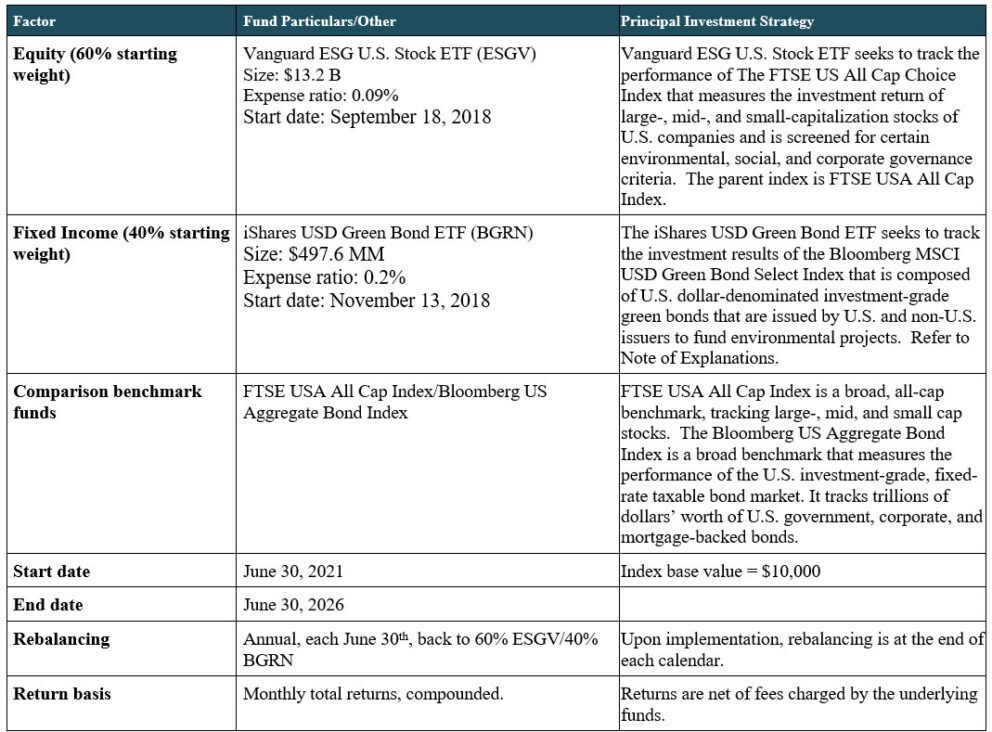
Notes of Explanation: iShares USD Green Bond ETF (BGRN) tracking index through February 28, 2022 reflect the performance of the Bloomberg MSCI Global Green Bond Select (USD Hedged) Index. Index returns beginning on March 1, 2022 reflect the performance of the Bloomberg MSCI USD Green Bond Select Index, which, effective as of March 1 2022, replaced the Bloomberg MSCI Global Green Bond Select (USD Hedged) Index as the underlying index of the fund. Sources: Fund documents and Sustainable Research and Analysis LLC.

Why Were These Two Funds Selected?
Fund selection emphasized mandate fit, scale, historical performance, expense ratio, management track record, and sustainability practices.

In addition to the investment and operations related factors, ESGV was selected because its tracking index provides broad U.S. market coverage that extends to large-, mid-, and small-cap stocks while applying ESG screens. Its proxy-voting choice feature is also material: shareholders may direct how the shares underlying their investment are voted under one of several available policies, rather than relying on a single uniform Vanguard voting approach.

As for the iShares USD Green Bond ETF (BGRN), the fund was also selected because it has outperformed the Bloomberg US Aggregate Bond Index over the trailing one-, three-, and five-year intervals and invests in U.S. dollar-denominated, investment-grade bonds whose proceeds are earmarked for environmental projects. Because green-bond issuance is concentrated among sovereign, quasi-sovereign, and investment-grade corporate issuers, BGRN behaves much like a conventional intermediate investment-grade bond fund from a risk standpoint, its differentiation is the use of proceeds rather than a distinct credit or duration profile, which is consistent with how closely its returns tracked the (non-green) Bloomberg US Aggregate Bond Index over the five year back testing period (2).

The Funds’ Sustainability Considerations
Equity sleeve: Vanguard ESG U.S. Stock ETF (ESGV)
ESGV tracks the FTSE US All Cap Choice Index, a broad, all-cap benchmark that applies a series of exclusionary ESG screens on top of standard market-cap weighting. Companies are removed from the index if they:
● Produce or derive significant revenue from adult entertainment, alcohol, tobacco (including, more recently, cannabis, which FTSE now classifies under tobacco), or gambling;
● Manufacture nuclear, chemical, or biological weapons, cluster munitions, or anti-personnel mines, or produce civilian firearms and ammunition;
● Own proved or probable oil, gas, or coal reserves, or have a primary business in the exploration, drilling, production, refining, or supply of oil and gas (a definition FTSE has broadened over time);
● Fail to meet baseline labor, human rights, environmental, and anti-corruption standards, as assessed against international norms such as the UN Global Compact; and
● Fail at least two of FTSE’s three board-diversity criteria: (1) at least one woman on the board, (2) diversity policies in place, and (3) diversity management systems in place. A company is excluded only if it fails two or more of these three; meeting any two is sufficient to pass.

Because the screen is exclusionary rather than best-in-class, ESGV retains broad market diversification across most sectors while removing an estimated 15–20% of the parent index’s names on controversy, conduct, and diversity grounds. Beginning February 1, 2023, Vanguard also extends proxy-voting choice to ESGV shareholders, allowing investors to direct how the shares underlying their investment are voted on individual proxy proposals.

Available proxy-voting policies: ESGV shareholders may select among Vanguard’s available voting options, including company board-aligned voting, Glass Lewis ESG policy voting, Vanguard-advised funds policy voting, mirror voting, and an Egan-Jones wealth-focused policy. These availability of a proxy-voting choice is a notable feature of ESGV because they allow investors to express governance preferences rather than accepting a single fund-wide voting approach.

Fixed income sleeve: iShares USD Green Bond ETF (BGRN)
BGRN tracks the Bloomberg MSCI USD Green Bond Select Index, which is composed of U.S. dollar-denominated, investment-grade bonds whose proceeds are earmarked for environmental projects. MSCI ESG Research evaluates each bond issuance against a four-part framework before it can be included:
● Use of proceeds: proceeds must fund one or more of six eligible categories — alternative energy, energy efficiency, pollution prevention and control, sustainable water management, green buildings, or climate adaptation (other environmental uses, such as sustainable forestry, are evaluated case by case);
● Process for project evaluation and selection: the issuer must have a defined process for determining which projects qualify;
● Process for management of proceeds: proceeds must be tracked and attributable to eligible projects; and
● Commitment to ongoing reporting on the environmental impact of how proceeds are used.

Performance Results and Commentary
Over the trailing five years, the Sustainable Balanced Portfolio produced a cumulative total return of 43.4%, or 7.47% annualized. The conventional 60/40 benchmark, composed of the FTSE USA All Cap Index and the Bloomberg US Aggregate Bond Index, returned 8.03% annualized over the same back-tested period. The sustainable portfolio therefore lagged by a modest 0.56 percentage points annually. On a $10,000 investment made on June 30, 2021, the sustainable portfolio would have grown to $14,336.80 versus $14,771.50 for the benchmark, a $434.70 difference, or roughly $0.23 per day over five years. For investors aligned with the portfolio’s ESG screens, green-bond exposure, and proxy-voting choice, the historical performance cost is limited. Still, for investors concerned about this lag, an alternate approach is presented below.
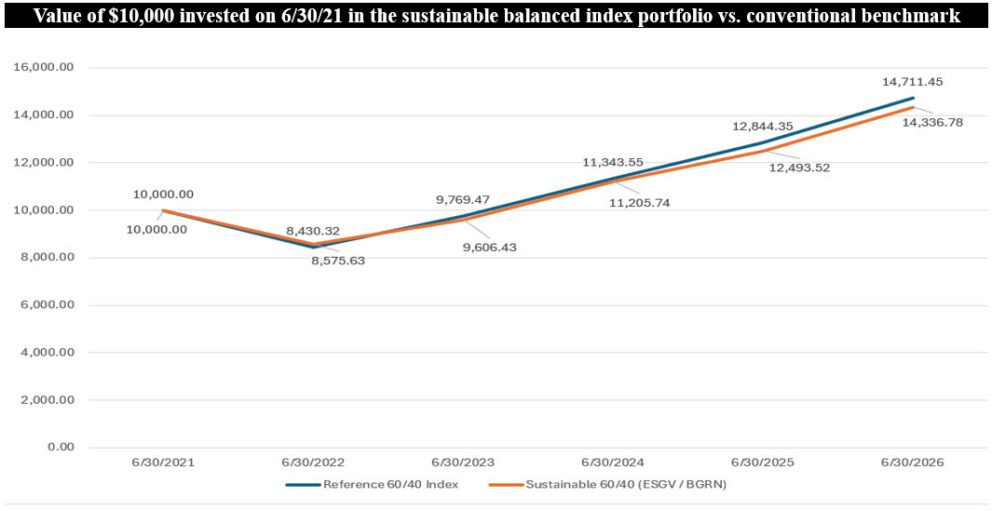
Notes of Explanation: The Sustainable 60/40 Index refers to the Sustainable Balanced Portfolio that is comprised of the Vanguard ESG U.S. Stock ETF (ESGV) and iShares USD Green Bond ETF (BGRN). The Reference 60/40 Index combines the FTSE USA All Cap Index and the Bloomberg US Aggregate Bond Index. Sources: Morningstar, FTSE Russell and Sustainable Research and Analysis LLC.

An Alternative Approach Produces Higher Returns
The portfolio’s results are driven primarily by the equity sleeve, given its 60% weighting and the outsized contribution from stocks over the past five years. A higher-performing labeled sustainable equity ETF can improve results, as shown by substituting the $2.6 billion Xtrackers S&P 500 Scored and Screened ETF (SNPE) for ESGV. SNPE, launched in 2019, tracks the S&P 500 Scored & Screened Index (formerly the S&P 500 ESG Index) that screens S&P 500 companies based on ESG scores that focus on the most financially material and relevant sustainability signals within specific industries. The index, which also applies various sustainability exclusions, has historically maintained a risk/ return profile similar to that of the S&P 500.

Over the five-year period, the S&P 500 Scored & Screened Index outperformed the FTSE US All Cap Choice Index. Replacing ESGV with SNPE would have lifted the Sustainable 60/40 Balanced Index to an annualized 8.82%, or 0.79 percentage points above the benchmark and $547.95 higher on a $10,000 investment. The trade-off is clear: SNPE improves historical return potential while offering a sustainable investing approach that screens stocks based on financially material ESG factors along with some exclusions whereas ESGV maintains broader market coverage, the fund applies ESG exclusionary screens and offers investors shareholder proxy-voting choices.
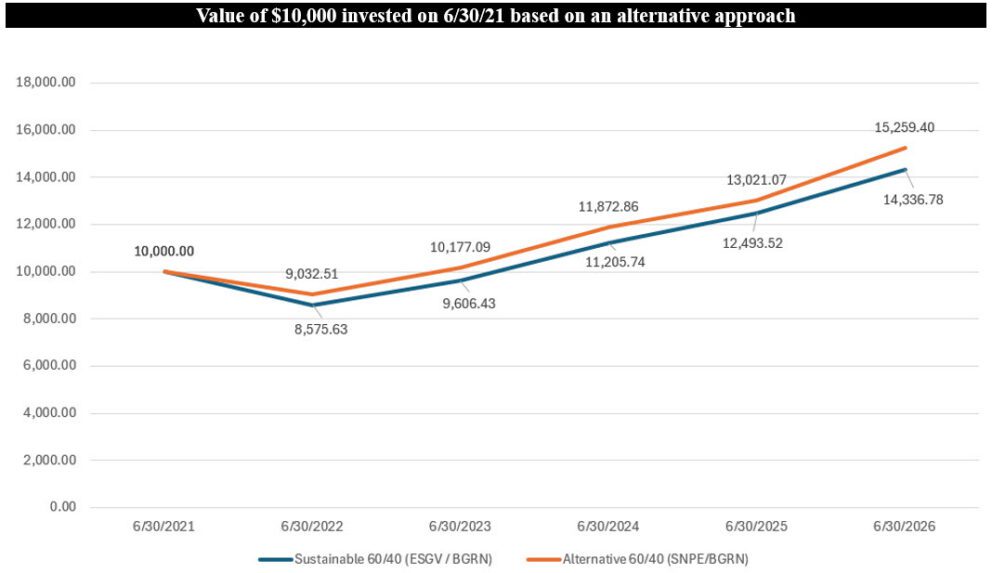
Notes of Explanation: The Sustainable 60/40 refers to the Sustainable Balanced Portfolio that is comprised of the Vanguard ESG U.S. Stock ETF (ESGV) and iShares USD Green Bond ETF (BGRN). The Alternative 60/40 Index is comprised of the Xtrackers S&P 500 Scored and Screened ETF (SNPE) and the iShares USD Green Bond ETF (BGRN). Sources: Morningstar and S&P Dow Jones Indices.
Expanding the Use of the Sustainable Balanced 60/40 Index Portfolio
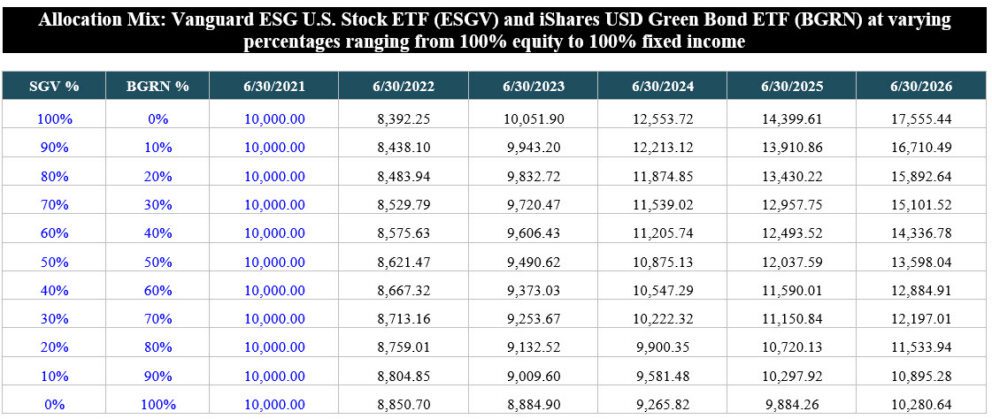
The same framework can be adapted across equity/bond allocations based on investment time horizon and risk tolerance. By way of illustration, long-horizon investors may prefer a 90%/10% stock/bond mix, while more conservative investors may favor a 20%/80% allocation. Back-tested based on a combination of the equity sleeve comprised of the Vanguard ESG U.S. Stock ETF (ESGV) and the fixed income sleeve comprised of the iShares USD Green Bond ETF (BGRN) are summarized in the table that appears below. Results display the value of $10,000 invested on June 30, 2021, to June 30, 2026 for varying allocations from 100% equity to 100% fixed income that produce results ranging from $10, 281 based on the most conservative investment strategy to $17,555.44 for the most aggressive investment strategy. The alternative approach would have produced superior results over the same time interval.  

Conclusion
The Sustainable Balanced 60/40 Index Portfolio is a credible core option for investors seeking low-cost balanced exposure with ESG screens, green-bond use-of-proceeds discipline, and proxy-voting choices, provided they accept a modest historical performance gap versus a conventional benchmark. Investors who prioritize maximum historical return over shareholder voting control and all-cap market coverage may prefer the SNPE-based alternative, but that decision should be framed as a conscious trade-off rather than a simple upgrade.

(1) Upon implementation, the Sustainable Balanced Index Portfolio is rebalanced at the end of the calendar year.
(2) The eight-month period in 2021-2022 during which the fund tracked the MSCI Global Green Bond Select (USD Hedged) Index did not have a material impact on the fund’s five year results. 

Notes of Explanation: Equity sleeve: Vanguard ESG U.S. Stock ETF (ESGV). Fixed income sleeve: iShares USD Green Bond ETF (BGRN). Value of $10,000 invested on June 30, 2021 and rebalanced to the target allocation every June 30th. Source: Sustainable Research and Analysis LLC.


YOU MAY ALSO LIKE


Sign up for free newsletters.


By submitting this form, you are consenting to receive marketing emails from: . You can revoke your consent to receive emails at any time by using the SafeUnsubscribe® link, found at the bottom of every email. Emails are serviced by Constant Contact

Research

Research and analysis to keep sustainable investors up to-date on a broad range of topics that include trends and developments in sustainable investing and sustainable finance, regulatory updates, performance results and considerations, investing through index funds and actively managed portfolios, asset allocation updates, expenses, ESG ratings and data, company and product news, green, social and sustainable bonds, green bond funds as well as reporting and disclosure practices, to name just a few.

A continuously updated Funds Directory is also available to investors.  This is intended to become a comprehensive listing of sustainable mutual funds, ETFs and other investment products along with a description of their sustainable investing approaches as set out in fund prospectuses and related regulatory filings.

Getting started

Many questions have surfaced in recent years regarding sustainable and ESG investing.  Here, investors and financial intermediaries will find materials that describe the various approaches to sustainable investing and their implementation.  While sustainable investing approaches vary and they have thus far defied universally accepted definitions, many practitioners agree that they fall into the following broad categories:  Values-based investing, investing via exclusions, impact investing, thematic investments and ESG integration.  In conjunction with each of these approaches, investors may also adopt various issuer engagement procedures and proxy voting practices.  That said, sustainable investing approaches will continue to evolve.

In addition to periodic updates regarding sustainable investing and how this form of investing is evolving, investors and financial intermediaries interested in implementing a sustainable investing approach will also find source materials that cover basic investing themes as well as asset allocation tactics.

Inesting ideas

Thoughts and ideas targeting sustainable investing strategies executed through various registered and non-registered sustainable investment funds and products such as mutual funds, Exchange Traded Funds (ETFs), Exchange Traded Notes (ETNs), closed-end funds, Real Estate Investment Trusts (REITs) and Unit Investment Trusts (UITs). Coverage extends to investment management firms as well as fund groups. 

Independent source for sustainable investment management company research, analysis, opinions and sustainable fund disclosure assessments