Observations:
• The $128.8 million Xtrackers Semiconductor Select Equity ETF (CHPS) is the top performing sustainable fund over the 12-month period ended on June 30, 2026 and the second-best performer in June. A thematic fund that screens and excludes companies based on sustainability criteria, it is the only dedicated sustainable fund focused on investing in companies that have business operations in the semiconductor industry, and it is up a whopping 196.02% and 11.79%, respectively. That said, the fund’s sustainability criteria are in the process of being dropped.
• Semiconductor stocks have been the standout performers of the past 12 months, driven overwhelmingly by AI infrastructure demand. Some of the largest fund’s holdings, including Micron Technology, Advanced Micro Devices, SK Hynix, Intel Corp. and Applied Materials, were up between 293% and 854.8% over the past twelve months to the end of June. The run hasn’t been linear, a reminder to investors of their exposure to a volatile sector. This is reflected in the volatility of similar thematic conventional funds. For example, the 3-year monthly standard deviation of returns attributable to the Fidelity Select Semiconductors Fund is 9.5 versus 3.8 for the S&P 500 Index, or 2.5X greater. Export-control tightening on advanced chips, HBM, and manufacturing equipment to China added periodic geopolitical risk, and more recently the sector saw a violent single-session shakeout on June 4-5, 2026, when Broadcom’s AI revenue guidance missed estimates and erased roughly $1.3 trillion in global chip-sector market cap. The chip-sector has since recovered.
• The fund, which was launched three years ago and charges 15 basis points, is dropping its sustainable investing approach effective July 7, 2026, by eliminating its ESG screening methodology. As of the same date, DWS/Solactive renamed the fund’s underlying index from the “Solactive Semiconductor ESG Screened Index” to the “Solactive Semiconductor Focus Index” and stripped out the Sustainalytics-based ESG screens (UN Global Compact compliance, ESG risk-score cutoff, controversial-weapons/tobacco/fossil-fuel exclusions) from the fund’s principal investment strategy. This is a “soft rebrand” that drops the ESG criteria from the underlying tracking index to sidestep the 80% naming obligation that has kicked in pursuant to the amended Names Rule promulgated by the SEC that went into effect on June 11, 2026 for fund groups with more than $1 billion in net assets and November 17, 2027 for fund groups above $10 billion in net assets and May 18, 2028 for fund firms with assets below that level. Changes like ones implemented by DWS/Solactive may fly under the radar screen of investors since the name of the fund is not undergoing a change. For further details, refer to article entitled Refer to the recently published article entitled “Sustainable Funds Meet the Names Rule: What to Watch as the June Deadline Lands.”
• CHPS has been the only sustainable thematic fund focused on semiconductors and once it completes its transition by August 5, 2026 it will join a cadre of 10 other semiconductor-focused index tracking funds with varying orientations and two conventional actively managed funds offered by Fidelity Management and Research. Refer to the listing below.
• Given the current availability of labeled sustainable and conventional mutual funds and ETFs, sustainable fund investors interested in continuing their focused exposure to semiconductors — or initiating a new position — have two fund-related options. Investors can waive their sustainability preferences and retain their investment in semiconductors via a conventional index fund, such as CHPS or one of nine other index-tracking funds.
• Alternatively, sustainable investors may consider a conventional, actively managed fund portfolio from a firm that integrates ESG considerations across asset classes, investment styles, and strategies. Such firms may also align their proxy voting and engagement practices with their approach to sustainable investing and stewardship. Setting aside performance and cost considerations, the $5.4 billion Fidelity Select Semiconductor Fund would qualify: as a firm, Fidelity integrates ESG considerations into its investment decision-making, and its stewardship guidelines extend to proxy voting and issuer engagement. In making investment decisions, Fidelity assesses an issuer’s management of financially material sustainability factors on a sector-relative basis, which helps it uncover potentially unpriced risks and opportunities.


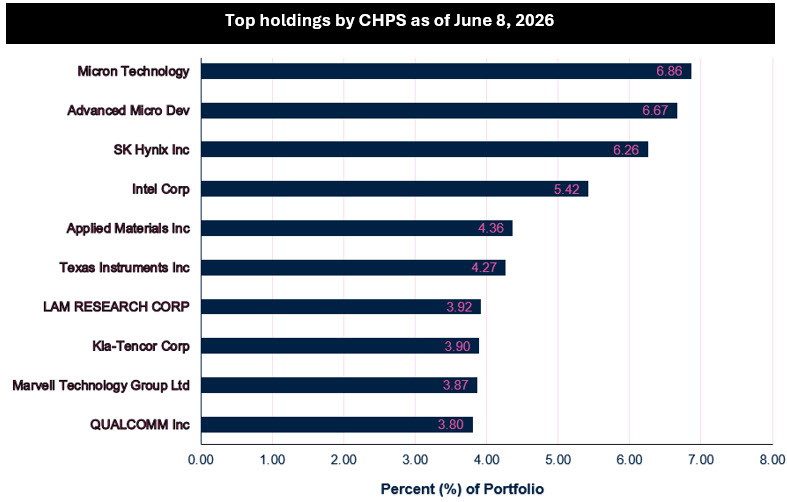 Notes of Explanation: Top 10 holdings data based on CHPS reporting as of July 9, 2026. Sources: Yahoo Finance and Sustainable Research and Analysis LLC.
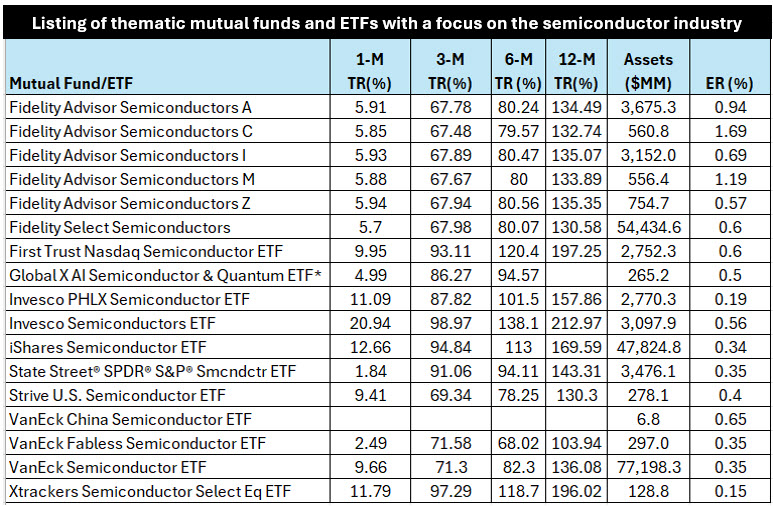 Notes of Explanation: All data to June 30, 2026. * Fund is not restricted to semiconductor stocks. The index tracks the performance of companies that are involved in the artificial intelligence (AI) semiconductor and quantum computing ecosystems. This includes companies involved in the design and manufacturing of semiconductor chips specifically for AI or AI-related applications, the development of AI-focused hardware systems, the provision of critical infrastructure and cooling equipment for AI data centers, and the advancement of quantum computing technologies. Sources: Morningstar and Sustainable Research and Analysis LLC.